
Nemzetközi Repülőversenyek (International Flying
Contests)
Budapest, Hungary, June 5th - 17th, 1910
Budapest, Hungary, June 5th - 17th, 1910
The Budapest Rákosmező airfield
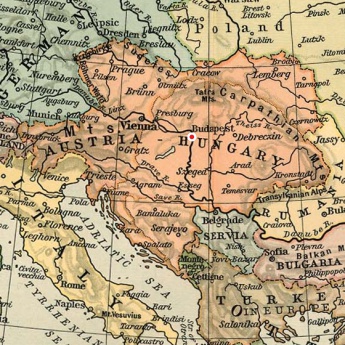
The expansion of the Hungarian aviation industry led to the construction of other airfields and it gradually lost its importance, particularly after WW1. In 1922 the Mátyásföld airfield was extablished and took over the position as Budapest's main airfield. Today only a monument reminds of the airfield, and although large parts are still undeveloped the area is increasingly used for housing.
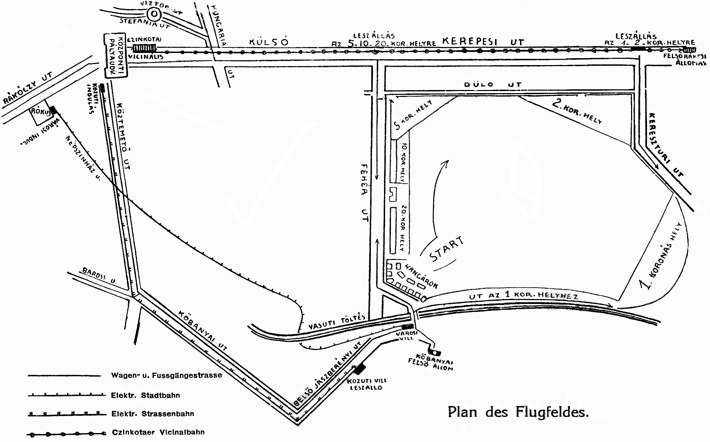
A plan of the airfield, from the German-language
version of the meeting program. It was originally
intended that flights should be made clockwise, with
turns to the right, but it was immediately overruled
when the pilots started arriving. We don't know the
exact layout of the course, but one source referred to
it as "a perfect hexagon". North is at twelve
o'clock. Click  here for a high-resolution version!
here for a high-resolution version!
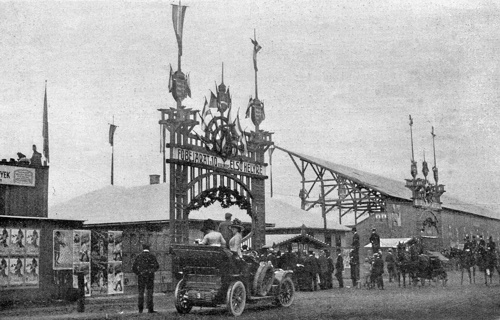
Two of the heavily decorated entry gates on the western side of the airfield, the nearest to the 10-Kronen area and the other to the 20-Kronen area. (1)
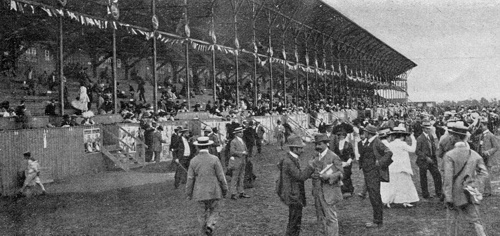
An interior from the grandstands. (2)
Approximate maps of the airfield, the cross-country
race course and Pischof's flight. Too see more
details, open them in Google Maps by clicking the
"full screen" symbol at the top right of the
menu bars!
Back to the top of the page