
France, August 7th - 17th, 1910
The world's first multi-stage air race

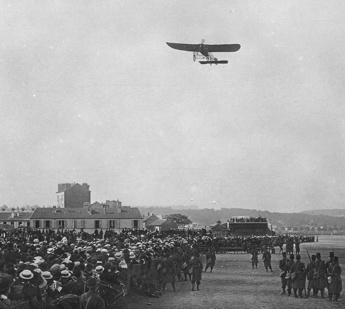
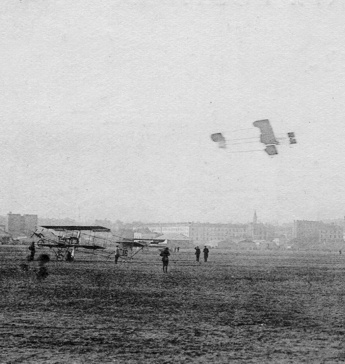
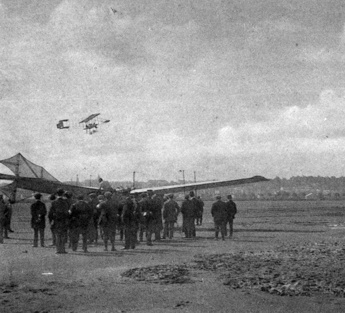
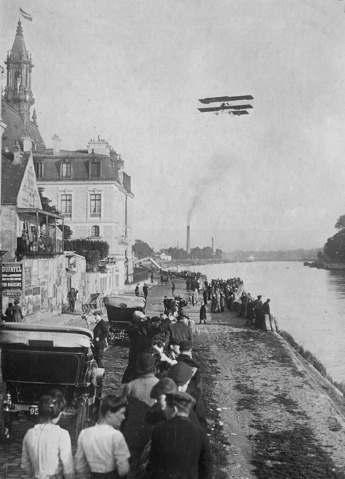
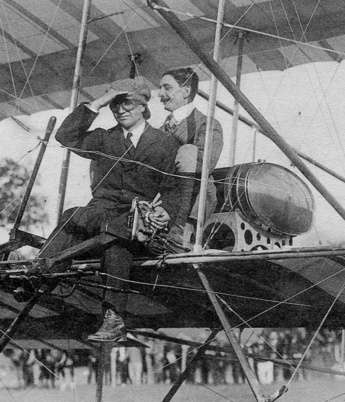
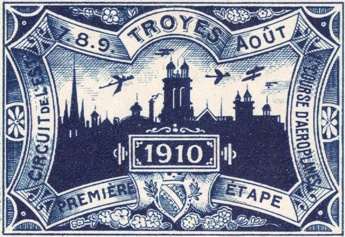
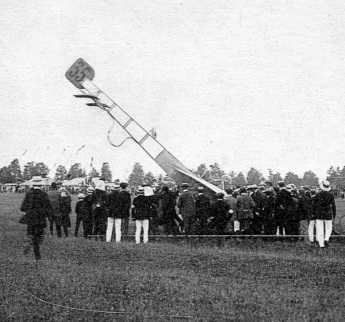
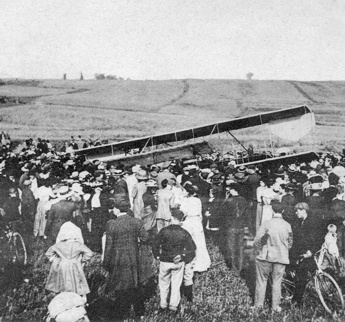
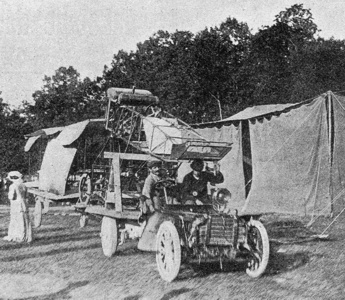
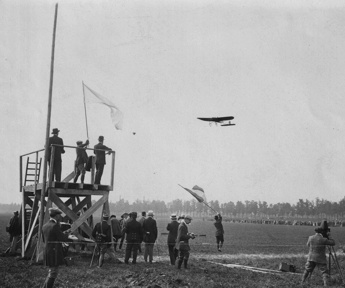
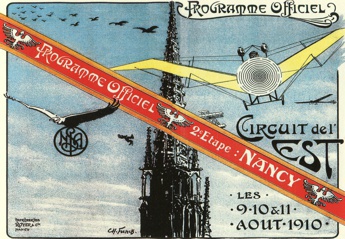
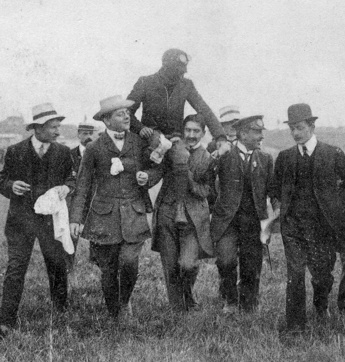
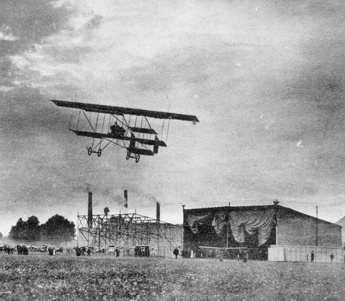
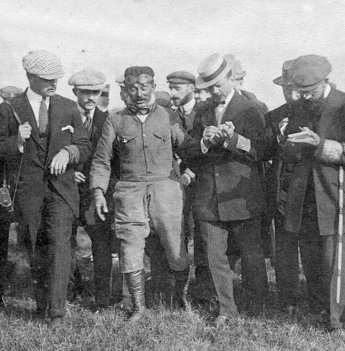
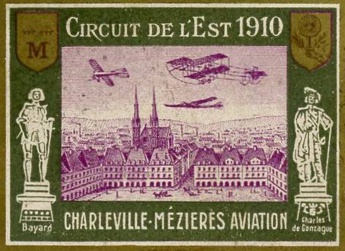
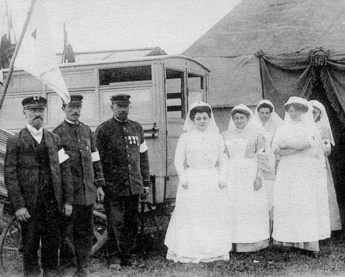
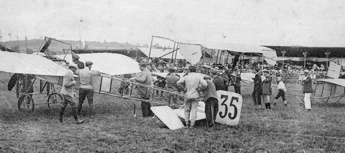
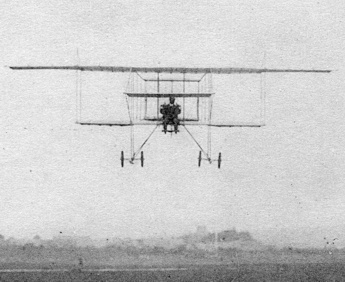
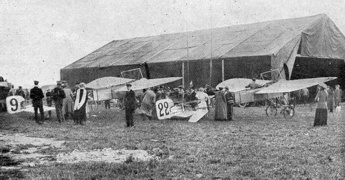
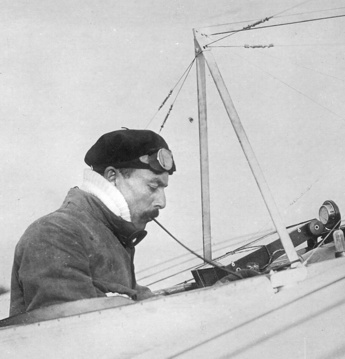
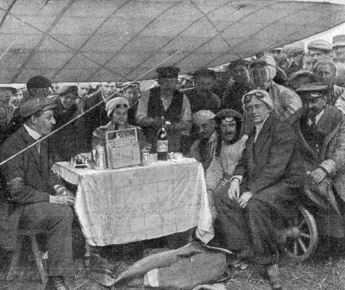
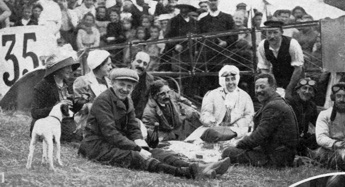
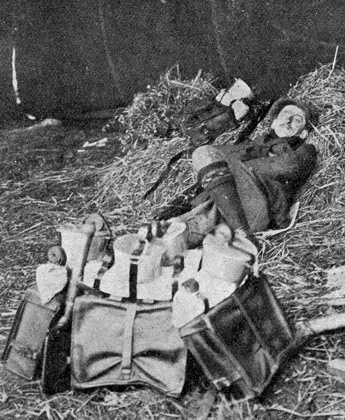
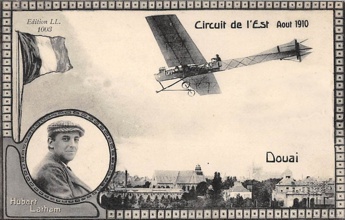
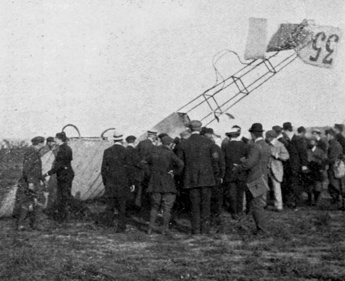
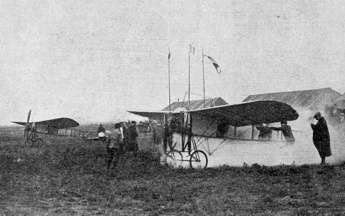
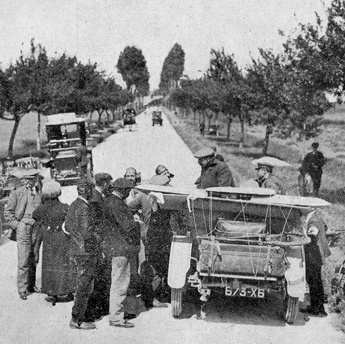
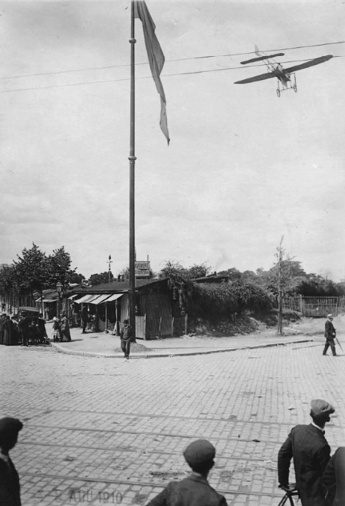
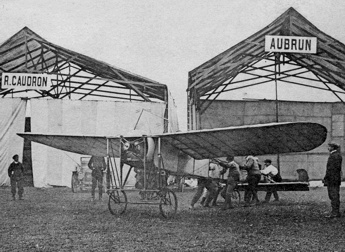
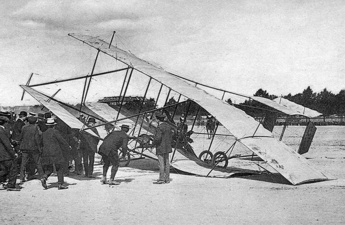
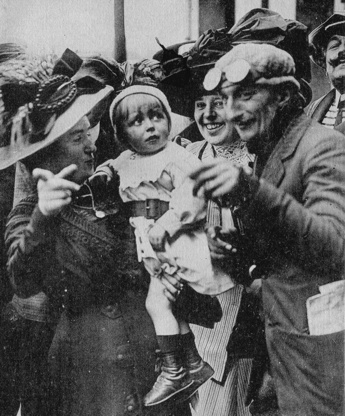
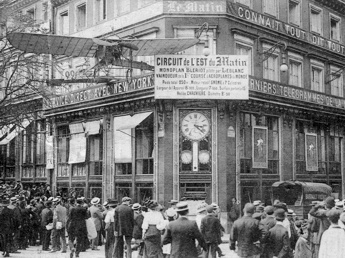
"Le Matin" was a daily newspaper, published
in Paris between 1884 and 1944. It was headed by Maurice
Bunau-Varilla, the uncle of early Voisin pilot Étienne
Bunau-Varilla. Around 1910 it was one of the four biggest
newspapers in France, each day printing around 700,000
copies. It had reached its position partly by sponsoring
sporting events, such as the yearly "Tour de France
Automobile", which was inaugurated in 1899, and the
1907 Peking-Paris automobile race.
On August 29th, 1909, the last day of the immensely
successful "Grande Semaine d'Aviation de la
Champagne", "Le Matin" announced that they would
sponsor a prize of 100,000 francs for the winner of a
five-stage "Circuit de l'Est" cross-country
airplane race with stops at Paris, Dijon, Belfort, Nancy,
Lille and Paris. The straight-line distance between those
towns was around 1,060 kilometres. The race was to be
held before 31 August 1910, and details of the contest
would be decided by a committee of aviators and other
competent persons.
Nothing even remotely similar had been attempted at that
time, and the announcement was greeted with both
enthusiasm and skepticism. Aviators and airplane-builders
of course welcomed the challenge, but some questioned the
capability of airplanes and pilots to cover such
distances through partly mountainous and forested parts
of the country, and proposed alternative routes over
flatter regions. Others realized the enormous effort and
the huge costs of charting and marking the course and
preparing airfields, a work that had to be performed in
cooperation with many different local organizations. "Le
Matin" cheerfully pointed out that people had said the
same thing when they announced the 2,300-kilometre "Tour
de France Automobile" ten years earlier, but "what is
2,300 kilometres for an automobile today?".
The composition of the organizing committee was presented
on November 4th, 1909. Among the fifteen members were
Édouard Surcouf, Robert Esnault-Pelterie, Ernest
Archdeacon, Count Charles de Lambert, Gabriel Voisin and
Léon Delagrange, together with several other people from
different aviation organizations. Paul Doumer, former
president of the Chambre des Députés and future president
of France, was elected chairman. Two subcommittees were
formed, one for developing the rules and regulations and
one for the practical preparations. By then, the course
was announced as Paris - Troyes - Dijon - Belfort - Nancy
- Reims - Lille - Amiens - Paris, which made eight
stages, totalling more than 1,100 kilometres.
At a meeting of the Féderation Internationale
Aéronautique in Paris on January 10th, 1910, the schedule
for the big international aviation meetings of 1910 was
decided. The date of the Circuit de l'Est was fixed
to August 7th - 21st.
The course went through several iterations during the
preparations, shortening it considerably in order to
simplify the course and avoid mountainous terrain. The
final course was presented on June 16th: Paris - Troyes -
Nancy - Mézières-Charleville - Douai - Amiens - Paris,
six stages officially totalling 785 kilometres.
The regulations were published on June 21st. They stated
that the winner of the 100,000 francs would be the pilot
who completed the course within the specified time in all
six stages and had the shortest total time. The stages
would be flown every second day, with a resting day
between each stage. Pilots who failed to complete a stage
were allowed to catch up and compete for the remaining
stage prizes, and for the many different local contests
that were organized at the staging airfields during the
resting days. At least six competitors had to enter, and
the entries had to be filed by midnight of July 15th.
During the following weeks the details of the race were
finalized, bit by bit. Local committees were organized,
supported by the regional branches of the French
Aéro-Club. The different local organizers were required to put up
10,000 francs of prize money for the first three
finishers of each stage, and in addition several special
prizes were donated towards contests during the resting
days at each airfield.
21 planes, representing eight manufacturers, had entered
already by July 8th, so the running of the race was
secured. "Le Matin" made the most of the publicity and
constantly published new information about the courses,
the entries, the local prizes and the doings of the
pilots as soon as there was any new information. From
July 11th to the start of the race they published
something about the race every day, most often on the
front page.
The French army of course also intended to make use of
the attention to aviation that event would generate.
Eight officers on different types of airplanes would
follow the route and make flights at the different
airfields. One of the objects was to practice
reconnaissance flights from the Nancy-Jarville airfield
along the German border. Officers were not allowed to
compete for cash prizes, so they could not participate in
any of the civilian contests, but they had their own
events. The town council of Paris committed 10,000 francs
to the purchase of trophies in the form of "works of
art" to the competing officers. The towns of Troyes,
Nancy and Mézières-Charleville also committed prizes for
officers. The activities of the military flyers raised
considerable controversy in Germany, where some writers
complained loudly about the "anarchy of the
unregulated air" and feared "airborne
espionage".
The final list of entrants contained 35 planes of 14
different makes: 16 monoplanes and 19 biplanes. All major
French manufacturers were represented. The list of pilots
included many of the most famous names, such as Hubert
Latham, Alfred Leblanc, Émile Aubrun, Léon Morane and
Georges Legagneux. Some of the entries had to be regarded
as doubtful, since no pilots were announced for the
planes, for example the three Nieuport planes and the two
Savary planes.
The final prize fund reached 235,000 francs, including
the different stage prizes and local prizes. To that sum
could be added the 25,000 francs prize put up by the
"Daily Mail" for the longest cross-country
distance flown in Britain or France between August 15th,
1909, and August 14th, 1910, which was also up for grabs.
On July 26th the complete list of airfields was
published. In the following days, long lists of the
villages and towns that would be passed by the flyers
were published. The course would be marked with flags
hoisted from church towers and other prominent buildings.
On the right side of the course it would be marked with
red flags with white bands, on the left side with white
flags with red bands. All in all, more than 400 such flag
posts were listed.
On July 27th, three German airships had flown for two
hours along the border opposite Nancy during manoeuvres
at Metz. As a reply to this, the Nancy committee decided
to create the "Prix de Frontière", which
involved flying from the Nancy-Jarville airfield to
Moncel-sur-Seille, a village at the border, some 20
kilometres away, around its church tower and back.
M. Guillemain, president of the pigeon-keeping society
"Le Ramier", organized a contest of homing
pigeons to coincide with the Douai-Amiens stage. What
would be fastest - an aeroplane or a pigeon?
On August 4th, "Le Matin" published interviews with sixteen
aviators who claimed they would certainly participate. Some of them
were already stationed at the Issy-les-Moulineaux
airfield in Paris where the race would start, and more
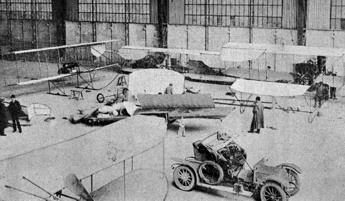
and more arrived every day. Some of their machines were
housed in the big airship hangars, but the Blériot and
Voisin teams had their own hangars.
Three of the flyers tried to fly to Issy-les-Moulineaux
on the day before the start of the meeting. Hubert Latham
took off at 6:20 from Mourmelon in his Antoinette and
finally reached Paris after almost ten hours, delayed by
rain, fog and wind. He had made two stops for refuelling, the
second of them lasting for more than three hours, because
he could not take off in the high crops of the field
until the fourth try. Charles Weymann left Mourmelon at
6:45 in his Farman and didn't reach Paris until seven
o'clock in the evening after three landings, being further troubled by rain, fog, turbulent winds and goggles
that misted up.
They were the lucky ones: Ferdinand de Baeder left Douai
in his Breguet at 11:25, but was forced to land with
engine troubles already some 20 kilometres from the
airfield. Louis Breguet, who followed the flight in his
car, had lost sight of the plane. It took him more than
an hour to find it, with the aid of a passing-by car
driver that de Baeder had stopped and sent to try to find
help. It wasn't until half past three that de Baeder
could try to take off again. By that time a big crowd
had gathered at the field, and they hindered him from
taking off into the wind. He tried to take off with the
wind from his side, but a gust caught his plane, which
crashed on the left wing, also damaging the propeller. De
Baeder had to return to Douai and take the train to
Paris. He stated that he would still be able to
participate, with a machine that could be prepared during
the night.
Many of the entrants had withdrawn for different reasons,
but on the day before the start 16 pilots, out of the 35
entrants, were still regarded as starters:
1. Édouard Nieuport (Nieuport)
4. Ferdinand de Baeder (Breguet)
5. Hubert Latham (Antoinette)
9. Émile Aubrun (Blériot)
10. Henri Brégi (Voisin)
12. René Metrot (Voisin)
16. Juan Bielovucic (Voisin)
18. Édouard Château (Tellier)
21. Georges Legagneux (Farman)
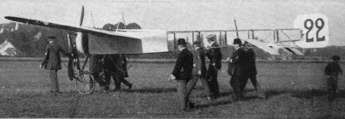
22. Alfred Leblanc (Blériot)
23. André Noël (Blériot)
26. Charles Weymann (Farman)
28. Guillaume Busson (Blériot)
30. Jean Daillens (Sommer)
33. Otto Lindpaintner (Sommer)
35. Julien Mamet (Blériot)
Sunday 7 August
Stage 1, Paris - Troyes (135 km)
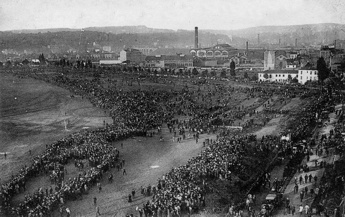
The great day had arrived! People gathered from all
across Paris to the big military exercise grounds at
Issy-les-Moulineaux, where the race would start. Already
at four o'clock the streets were full of automobiles.
Thousands of people arrived at the Gare Saint-Lazare
railway station and on the Place de la République 4,000
people fought over the places available on the around
twenty omnibuses that had been organized. According to
some estimates, the rather incredible number of half a
million people had gathered around the airfield.
The first stage would take the pilots a straight-line
distance of around 135 kilometres to the south-east, from
Issy-les-Moulineux, in the south-west part of central
Paris, to Troyes. The course started by following the
Seine, but deviated to the north at Corbeil-Essonnes,
making a straighter line across the countryside. It did
not pass any major towns before reaching Troyes.
The Blériot hangars opened for the first test flights
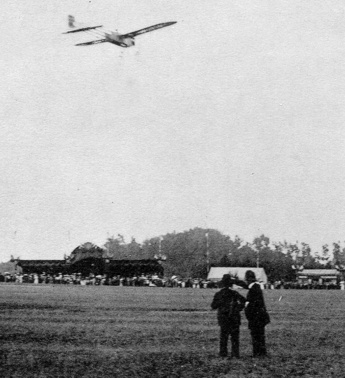
soon after four o'clock. Noël took off at 4:05 and
flew several laps at low altitude. At 4:45 Leblanc flew
four fast laps around the field. He was followed by
Lindpaintner, who flew above the hangars, and then by
Bielovucic, Latham and Brégi, while the crowds around the
airfield applauded and cheered. The sun rose red against
a blue sky and the weather looked promising, without any
wind at all.
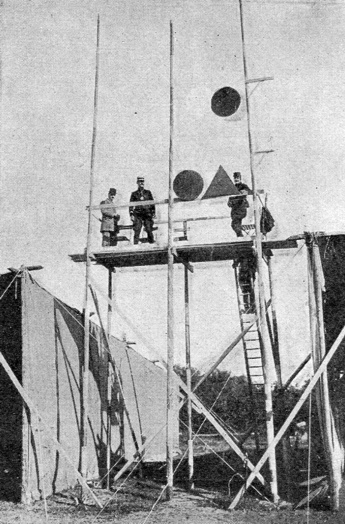
The timers and other officials, headed by the
"commissaires sportifs" MM. de Kergariou,
Gasnier and Fournier, head timer M. Audistière, and the
secretary of the commission M. Surcouf, were in place at
their positions at five o'clock. It had previously
been announced that the pilots would take off in race
number order at five-minute intervals, with the first one
at five o'clock. This rule was obviously not applied
- when Louis Blériot, soon after five o'clock, looked
at his watch and asked the officials if his pilots could
start, he was told that they could go when they were
ready. The Blériot crews immediately got into action.
Aubrun took off at 5:13, followed by Leblanc at 5:18 and
Mamet at 5:22. Lindpaintner was also ready early and took
off at 5:30.
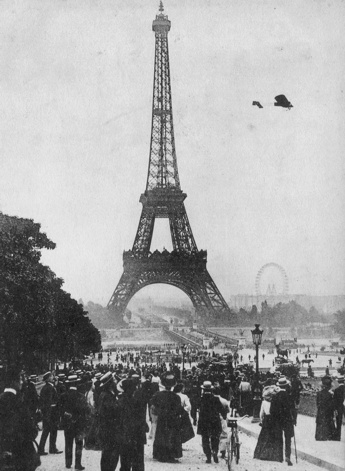
Shortly before six o'clock a Blériot was unexpectedly
seen approaching from the direction of the Eiffel Tower
in the north-east. After landing, two people dismounted.
The pilot was the American John Moisant, who had taken off
from Étampes at 5:02 together with his friend Roland
Garros. He had tried to enter the contest he but been
denied, since he didn't have a pilot's licence.
He stated that he intended to follow the course without participating in the
comtest, but he later changed his plans...
Busson took off at 6:05 in the fourth Blériot. The crowds
kept pressing against the gates and it was almost
impossible to enter the airfield. Weymann had forgotten
to keep one of the armbands that gave access to the field for himself
when he handed them out to his crew, and he was not let
in when he arrived at the gates. It took quite a while
before he could find an official that recognized him.
Brégi took off at 7:40, followed at 7:53 by Legagneux.
Shortly before eight o'clock in the morning a phone
call from Troyes brought the news that Leblanc, Aubrun
and Lindpaintner had arrived. They had all been troubled
by fog soon after the start. In order to simplify
navigation, Aubrun had decided to follow the marked course
along the Seine, which wasn't the shortest route. He
stated that he still wasn't sure of his way until he
reached Guignes, but then the mist cleared, and he could
follow the given landmarks. Leblanc had decided to follow a
shorter compass course towards Boissy-Saint-Léger, but
then briefly lost his course in the fog and was forced to
diverge to the south, towards Corbeil-Essonnes, where he
found his way again. The two saw each other at
Nogent-sur-Seine and then followed the same route in the
sunshine, more or less at the same pace and seeing each
other from time to time. They landed without further
troubles at the Troyes airfield, Aubrun first, followed
35 seconds later by Leblanc. Their times were 1 h 37:25
and 1 h 33:20, respectively. Leblanc also won a prize
offered by the Aéro-Club of Corbeil to the first of the
competitors to pass their town. Leblanc and Aubrun both
stated that their planes and engines had worked
flawlessly.
Lindpaintner had also had a trouble-free flight,
initially following the Seine with the help of the map
that he had strapped to his left thigh. He claimed that
he was frozen stiff, and he was bleeding from a hand that
had been cut by a loose rigging wire. His time was 2 h 00:25.
Mamet, on the other hand, lost his bearings completely in
the fog. After flying some 165 kilometres almost due
east, far north of the race course, he landed at Coole,
more than fifty kilometres north of Troyes. He walked to a
post office where he asked some surprised farmers about
the way and then impressed them by starting the engine
himself, climbing on board the rolling plane and then
taking off. He reached the airfield at Troyes without
further problems at 10:40, having spent 5 h 08:09. His
landing was also spectacular - he bounced and overshot
and almost hit a hangar, but managed to jump out of his
rolling machine and brake it by grabbing the fuselage
framework.
At half past eleven a second biplane was seen from the
Troyes airfield. It looked like the pilot was lost and
looking for the way, but suddenly the plane started to
descend and disappeared from sight behind the trees that
surrounded the airfield. What had happened? Cars and
motorcycles left the airfield and soon found Legagneux,
who had run out of fuel and was forced to land close to a
cemetery at Gare Troyes-Preize, less than three
kilometres from the airfield. The problems were soon
fixed. His fellow pilot and past competitor Louis Paulhan
provided him with needed fuel and helped him start the
engine, and he took off and flew to the airfield. His
time was 3 h 59:22. He had also been delayed by an
earlier landing near Provins, where he had been forced to
repair an aileron.
Busson was also troubled by the fog, but found clear air
at Villejuif. His engine started to misfire over
Lieusaint, after some 35 kilometres, and he was forced to
land and change the spark plugs. He took off again and
quickly reached an altitude of 200 metres. After a while,
he realized that he had lost his way and deviated to the
north. After turning southwards to find his way back, the
engine suddenly stopped again. He circled down, with his
propeller stationary, and landed in a wheat field close to
Moissy. He managed to avoid a stone wall at the edge of
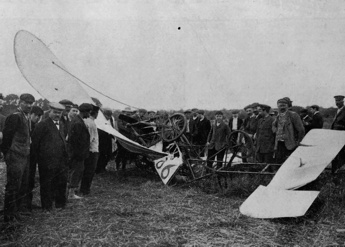
the field, but ran into a ditch after touching down. The
machine somersaulted and was completely wrecked, but the
fortunate Busson could climb unharmed from the tangled
mass of wood, fabric and wires. He arrived at the
airfield in Troyes by car at around one o'clock.
Brégi also tried a straighter course north of the Seine,
but his engine failed already some 30 kilometres east of
Paris, at Pontcarré. He managed to land safely, but
couldn't take off again, since the little field where
he had landed was situated in the middle of a forest and
surrounded by trees. He told the press that he intended
to disassemble the plane and transport it by road in
order to participate in the remaining stages.
Weymann finally took off at 9:13, incredibly carrying
neither maps nor a compass, trusting that he could get
directions from the ground on his way. He landed for the
first time in Moissy, some 35 kilometres from Issy. After
getting directions and taking off he started to get lost
and landed some six kilometres from Coulommiers, around 20
kilometres north of the course. He found a bypassing man
by the name of Louis de Salvert and took him on board as
a passenger, in the hope that he would be able to help him
find the way. It didn't work out very well, since he
was forced to land after 20 kilometres to disembark his
guide, who was getting seasick. After these adventures,
Weymann managed to reach Troyes without further
incidents. His time was 4 h 17:27.6.
The other pilots withdrew for different reasons: Château
made some tests and stated that his machine was not in
good shape. Noël declared that he withdrew from the first
stage, but intended to complete the other stages. De
Baeder hadn't been able to get his replacement
machine ready. Latham announced that he was exhausted
after his difficult flight the day before and didn't
feel well, but later in the afternoon he took off and
made a one-hour flight to the family chateau at
Maillebois, where he visited his mother and had a couple
of days of rest. Bielovucic stated during the morning
that he would take off in the afternoon, but in the end
he never did, discouraged by engine problems. Noël,
Latham, Metrot and Bielovucic were still considered to
have made official starts, since they had answered to the
official call-up in the morning. They were therefore
eligible for prizes during the following stages.
After arriving in Troyes, Lindpaintner and Weymann made
some test flights during the afternoon, the latter also
carrying a passenger, a reporter from "Le
Matin". Roger Sommer
also made a flight in one of his machines, flying above
the town and circling the cathedral. In the evening the
local committee, together with M. Lemblin, the mayor of
Troyes, offered a dinner for the pilots and the press.
Monday 8 August
Local contests, Troyes
The weather was sunny and very hot at the airfield at
Pont-Hubert, some 2.5 kilometres east of the centre of
Troyes, but there was perhaps a little bit less flying
than the organizers had hoped for. Alfred Leblanc was in
bed at his hotel, sick with fever and speculating that he
had eaten some dodgy pâté. The other Blériot pilots were
out in cars preparing for the next day's stage, which
was predicted to be the most difficult one, over the
forests and valleys along the Vosges.
It was left for the biplane pilots to contest the
day's prizes. The "cross-country" prize,
which was actually a race of four laps around a
three-kilometre course, was the first to be contested,
between nine and one o'clock, but nobody actually
took off until half past eleven. Weymann covered the
distance in 11:56.4, beating Legagneux's 13:13.0. The
prize for passenger flights was contested after four
o'clock in the afternoon. Weymann was the only one to
try, winning by covering the same distance as the
cross-country in 16:42.4. The prize for altitude was
contested between five and six o'clock in the
afternoon. It was won by Lindpaintner, who reached 450
metres and beat Legagneux by 150 metres. A prize for the
shortest take-off run was also offered, but there were no
entrants.
After returning from his reconnaissance drive, Mamet
decided to make a flight, finally giving the crowds a
monoplane to look at. He took off and flew some circles
around the field at good speed, but after landing he ran into a hole in
the ground and the machine stood on its
nose, fortunately at low speed. The only damage was a
broken propeller and some dents on the cowling.
The last flights of the day were made by Sommer, in
Lindpaintner's machine, and by Weymann, who thrilled
the crowds with some roller-coaster climbs and descents.
Brégi's machine had arrived during the afternoon and
was being prepared for the next stage. Towards the
evening it was announced that Leblanc was feeling better
and was confident of being able to participate in the
morning.
Tuesday 9 August
Stage 2, Troyes - Nancy (160 km)
The weather had turned worse, and it was misty in Troyes
in the morning. The second stage passed forests, valleys
and hills, and the organizers had tried to find a route
that would allow safe emergency landings, but this made
the recommended course longer and more sinuous.
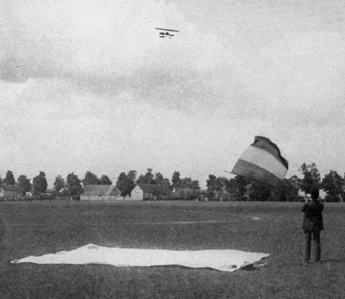
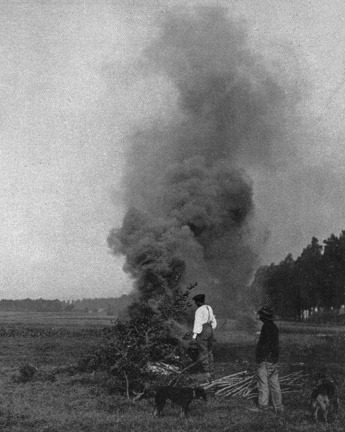
During the first stage there had been complaints that it was difficult
to see the flags that marked the course. Therefore, the
organizers had instructed officials along the course to
encourage people to light bonfires with smoking wet straw
along the course and also indicate the course by laying
bed sheets or other large sheets of cloth on the ground
before the second stage.
The first pilot to fly during the morning was lieutenant
Mayolles, one of the military pilots who followed the
race. He made a short flight in his Wright, but landed
heavily and broke a landing skid and a wing.
Lindpaintner was the first of the competitors to start.
He took off at 5:14, circled the airfield and then
disappeared towards the east. He was followed eleven
minutes later by Legagneux, and then by the two Blériot pilots,
first Aubrun at 5:33, after a take-off run of only 40
metres, and then Leblanc at 5:40. Then Weymann took off,
but he decided to give up and return after only a few
kilometres. He made a rather heavy landing and one of his
landing skids was broken.
During the morning the weather got worse. Brégi took off
around ten o'clock in heavy rain, but he too decided to
return and withdraw from the stage of after only a short
flight, also suffering from engine problems.
Mamet's start was delayed by the repairs after his
accident the day before. He made some ground tests, but
his engine didn't run well. By that time, reports of
bad weather were coming from Nancy and Louis Blériot
advised Mamet against taking off. He decided to
withdraw from the stage and transport the machine by road
directly to Mézières-Charleville.
The leading Blériot pilots had decided to go for the
shortest straight route, rather than following the marked
course. Leblanc caught and passed Aubrun at Wassy, almost
halfway along the course. Aubrun decided to follow
Leblanc, trusting that Leblanc would be on true course
and calculating that he would not lose any further time.
Lindpaintner had engine problems and was forced to land
at Valleret, close to Wassy, in a small field
surrounded by hedges. He rolled into a ditch and broke a
landing skid. He was exhausted and retreated to a hotel
in Wassy to rest, while his crew, headed by Roger Sommer
himself, arrived and started working on the machine. The
repairs were finished around ten o'clock, but it
would have been a very difficult take-off under any
circumstances, and the heavy rain made Lindpaintner give
up. At 14:20 he announced that he would travel to Nancy
by car. His machine finally arrived during the evening,
having been dismantled and transported by road.
Legagneux also suffered from the adverse winds and the
fog. He got lost several times and wasted a lot of time
trying to find his way. He had to land three times before
completing the course. The first landing was at a place
given as Bainville, where he had run out of fuel. He was
given some fuel by locals, and three of them also helped
him hold down the plane before the take-off. He then had
to land again at Viterne, around fifteen kilometres from
his destination, because his tank was empty again. This
time there were no helping locals around - they were
actually quite hostile to this noisy "machine of the
devil", so he had to wait until his crew, headed by
Robert Martinet, arrived. If the "Bainville"
where Legagneux made his first landing was
Bainville-sur-Madon (there are a couple of other
Bainvilles in the region, but far further from the
course) he must have had his directions completely wrong,
since Viterne was only five kilometres away, and actually
slightly further from Nancy. The confusion apparently
continued, since he had to land one more time at
Saint-Nicolas-de-Port, some seven kilometres south-east
of the airfield, to ask for directions.
It was raining heavily at the Nancy-Jarville airfield,
and few people were there to watch the arrivals. Leblanc
was first, almost exactly at eight o'clock, followed
less than two minutes later by Aubrun. Leblanc's time
was 2 h 19:49, while
Aubrun's time was 2 h 27:52.
Leblanc stated that the smoking bonfires were a great
improvement and that he had had no problem finding his
way, but that he had been troubled by turbulence when
flying above the forests. Aubrun said that had been
troubled by fog during the beginning of the course and
had been forced to trust his compass until he saw Leblanc
and decided to follow him.
The few people who remained at the rain-soaked airfield
had to wait almost three hours before Legagneux arrived
at 10:57, after a total time of 5 h 30:26. He estimated
that he had flown more than 250 kilometres, but stated
that his machine had thankfully worked perfectly. Apart
from his navigation problems, he had also been troubled
by the turbulence and complained that he had been
freezing badly. As opposed to the Blériot pilots, who
were partly protected by a fuselage and kept somewhat
warm by the engine in front, the pilots of the Farman and
Sommer biplanes were completely exposed to the elements
and the slipstream.
The outcome was that Leblanc led the race, with a time over
the first two stages of 3 h 53:09, eleven minutes in
front of Aubrun and more than five and a half hours in
front of Legagneux. In order to compensate the spectators
at the airfield for the lack of action, the organizers
decide to open the hangar area, so that they could see
the machines at close distance.
Wednesday 10 August
Local contests, Nancy-Jarville
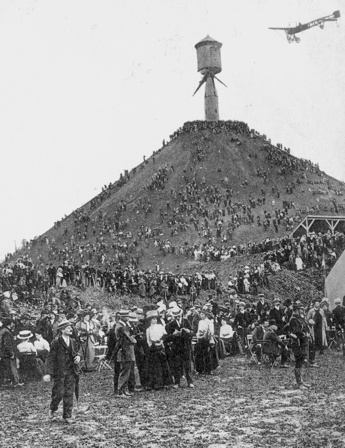
The weather improved during the morning, and around
50,000 people came to the airfield, a field at
Jarville-la-Malgrange, some 3.5 kilometres south-east of
the centre of Nancy, which was normally used for horse
racing. Many of the spectators gathered on the
"crassiers", the huge conical slag heaps that
had been generated by the neighbouring ironworks.
Weymann, who never started the second stage, took off
from Troyes early in the morning and flew to Mourmelon,
intending to join the race again at Mézières-Charleville.
Much of the focus centred on the border against Lorraine,
part of the "annexed territories" that were
conquered by Germany in 1871, less than 20 kilometres
away. The army flyers had announced early in the morning
that they would make practice reconnaissance flights
along the frontier, and for the civilian pilots there was
the "Prix de la Frontière", offered for the
fastest flight to the border and back. A whole convoy of
reporters jumped into their cars to travel to
Moncel-sur-Seille, the village by the border, north-east
of the airfield, that would serve as turning-point.
Around 3,000 people had already gathered there. The
German press was very critical against the flights, which
they regarded as a blatant French provocation. Some
militant writers, particularly those of the
"Straßburger Post", suggested that any French
planes that approached the frontier should simply be shot
down. The French officers were ordered to keep at a safe
distance from the border in order to avoid incidents.
The first of the military pilots to take off was
lieutenant de Caumont, but he landed heavily after two
laps around the airfield and wrecked his Sommer, the
machine flown by Legagneux at Reims. He was followed by
lieutenants Camerman and Féquant in their Farmans, with
lieutenant Vuillerme and general Manoury as passengers.
Camerman was first to arrive at Moncel-sur-Seille,
saluting the flag that was waved in front of the
mayor's office. He was followed some minutes later by
Féquant.
The only contestant of the "Prix de la
Frontière" was Legagneux, who arrived half an hour
after the military pilots. He had promised his father to
fly all the way to Metz, but the prefect had discouraged
him, saying that it would be too much of a provocation.
He still crossed the border, at Chambrey, and even
continued to fly above the German installations at
Château-Salins, six kilometres beyond the border, before
turning back towards Nancy, where he circled the
cathedral before returning to the airfield for landing.
His flight of 45:34 won him the prize.
The return of the Legagneux and the military pilots
flyers was celebrated as a French victory - the reporter
from "Le Matin" chauvinistically stated that
"this was not a sporting festival, it was a
patriotic manifestation, a revenge!".
Back at the airfield, there were also a couple of prizes
to be won. Legagneux was the hero of the day. His machine
was serviced while he was interviewed by the press after
returning, and he then took off to fly for the altitude
prize. It was estimated that he reached 700 metres, but
the official result was only 500 metres, still beating
Lindpaintner's 350 metres by a good margin.
Leblanc was reported to still suffer a bit from his
illness. He went out to the airfield to oversee the
maintenance of his machine, but he didn't do any
flying. Aubrun made two flights, first in a borrowed
three-cylinder Anzani-engined Blériot, then in his racing
machine, impressing the crowds with his speed.
Paul de Lesseps, brother of the more famous Jacques, flew
a couple of low laps in a Sommer. Lindpaintner also flew,
and later in the evening Roger Sommer tested both de
Lesseps' and Lindpaintner's machines. Legagneux
beat de Lesseps and Lindpaintner in the contest for the
longest total distance flown over the airfield.
Thursday 11 August
Stage 3, Nancy - Mézières-Charleville (160 km)
The weather did not look promising in the morning, with
rain showers and threatening clouds. Nevertheless,
Leblanc, Aubrun and Lindpaintner took off in succession
and disappeared to the north, at 5:31, 5:44 and 5:55
respectively.
Legagneux was next to try, but he landed immediately. He
made two more short test flights, but despite his
crew's efforts his engine didn't run well, so he
had to give up and return to his hangar. Bielovucic also
tried, but his machine was apparently badly rigged, and
because of the nose-down attitude he couldn't make it
leave the ground. After a while, his crew started to
dismantle the plane to once again transport it by road.
Lindpaintner got into trouble already after around six
kilometres, near Eulmont. He encountered some turbulence
above the forested hills and the rigging of his tail
surfaces failed, so he had to cut the engine and land. He
fortunately managed to find some open space and make a
safe landing. Sommer and his crew didn't notice
Lindpaintner's problems and continued along the road
towards Mézières-Charleville, so Lindpaintner had to fix
the rigging himself. He then tried twice to take off, but
the field was too uneven, so he had to give up. Once
again, his machine too had to be transported by road to the
next airfield.
Meanwhile, Leblanc finished the stage without any major
delays and landed at 7:36 after a flight of 2 h 05:01. He
said that it had been a very difficult flight because of
the thundery weather, but also very interesting, flying
above Verdun and Sedan, and all the battlefields and
monuments of the war 39 years before. His roll map
hadn't worked and he had had to trust his memory of
the course and his knowledge of the area after several
balloon flights in the region. He said that he almost
cried of joy when he recognized the river Meuse through
the haze, knowing that he would be able to follow the
marked course to the finish line.
But what had happened to Aubrun? The Blériot crew had watched
in vain for him at Verdun when Leblanc had passed. They had
telephoned places along the course and asked the military
units in the area to watch for him, but there were no
news. It turned out that Aubrun's map had been blown
out of the cockpit, already early during his flight.
Since he didn't think he had any chance to find his
way without it, he turned westwards instead and found his
way to Châlons-sur-Marne, in a part of the country that
was more familiar to him. He landed at the Camps de
Châlons, where he found some officers who could provide
him with new maps, and he also got his fuel tanks filled.
His flight, first westwards and then northwards, was a
substantial detour, and on top of that he had spent forty
minutes on the ground. He finally arrived at
Mézières-Charleville at 9:29, after a total time of 3 h
42:26.
Legagneux and his crew worked all through the day trying
to fix his engine, and he made several test flights. At
15:35 in the afternoon it finally looked like he could
make a proper start. He flew several laps around the
airfield and then set off towards the north, but his
engine still didn't run well. Since he realized that
it would be impossible to reach Mézières-Charleville in
time to be officially timed he gave up and turned back to
land again. He stated that he would nevertheless,
whatever it would take, fly the remaining stages all the
way back to Paris, and immediately started trying to find
a replacement engine.
This meant that there were only two pilots left in the
big race for the 100,000 francs. Because of Aubrun's
difficulties Leblanc's lead in the total standings
had increased to 1 hour 53 minutes.
Weymann did not reach Mézières-Charleville during the day
as planned. He took off from Mourmelon, but had engine
problems some three kilometres from Reims and was forced
to land, damaging his machine.
Friday 12 August
Local contests, Mézières-Charleville
An estimated 50,000 spectators had gathered at the
airfield, which was situated some 3,5 kilometres
south-east of the centre of Mézières-Charleville, at the
village of Villers-Semeuse. Weymann flew in during the
morning. He had spent the night in Reims after
getting a replacement engine installed at the Bétheny
airfield.
Five pilots flew during the day: Sommer, Weymann, Mamet
and the military pilots Camerman and de Caumont. Aubrun
was away in his car, preparing for the next stage.
Leblanc was at the airfield, but obviously didn't
want to take any risks. Sommer was first in the air, at
around two o'clock in the afternoon. He had promised
his family that he wouldn't take part in any
contests, but that didn't stop him from making
several exhibition flights during the race.
Weymann impressed the crowds with his acrobatic flying
and won the precision landing contest by touching down
only 1.95 metres from the target line. He also won the
prize for the longest total time in the air. Mamet made
several short flights. His not very impressive altitude
of 100 metres should not have been enough to qualify for
the altitude contest, which required a minimum of 300
metres.
Around five o'clock in the afternoon, while Mamet and
Weymann contested the precision landing prize, a biplane
arrived. It was Legagneux, who had finally, at five
o'clock in the afternoon the day before, managed to
locate his ignition problems and had been given a magneto
from Paul de Lesseps' Sommer. He circled the airfield
and landed in front if the grandstands, before being
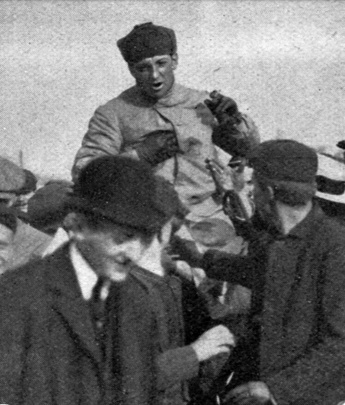
carried in triumph to the buffet, where the committee
congratulated him for his flight. He had left Jarville at
10:20 in the morning, having arranged that his friends,
M. Hinstin, director of the Grégoire car company, and his
driver de Marne, would drive before him in their fast
six-cylinder car, decorated with Grégoire's blue and
orange flag, so that he would be able to follow the car
and the dust trail that it raised. He had landed at
Ambly-sur-Meuse and had a three-hour lunch together with
his guides and Robert Martinet, the owner of the machine,
before continuing the flight to the airfield. On the way,
he had circled the cathedrals of Toul and Sedan, his
seventh and eighth cathedrals.
Around half past five another biplane was heard and seen
from the airfield. It was Lindpaintner, who had flown
from the Sommer works at Douzy, some 25 kilometres
south-east of the airfield. He never reached the
airfield, though. He disappeared from view, and from the
direction that he had come from the only thing that could
be seen was a flock of frightened birds. Weymann offered
to search for Lindpaintner and quickly took off in the
increasing wind, while his mechanics, who had looked
forward to a quiet evening after their hard work during
the previous days, murmured. People at the airfield
started worrying when he hadn't come back after a
while, and the reporters from "Le Matin" set
off in a car. When they had passed the village of
Nouvion-sur-Meuse, around five kilometres south-east of
the airfield, they met Weymann on a bicycle with
Lindpaintner as passenger. It turned out that
Lindpaintner had decided to land because a rigging
problem made the plane pull to the right. His had landed without problems, but when Weymann tried to land nearby
he misjudged the effect of cutting the engine with the
wind from behind and undershot the field. The landing
gear was ripped off when the plane hit a wire fence, and
he then crashed into a road bank.
This meant that Weymann was grounded the next day, but it
was expected that both Mamet and Legagneux would complete
the next stage together with Leblanc and Aubrun. Towards
the end of the day it started raining and the wind
increased further, making people question whether it
would be possible to take off at five o'clock the
next morning.
Saturday 13 August
Stage 4, Mézières-Charleville - Douai (140 km)
The flags were blown horizontally from their poles in the
morning. At noon, the average wind speed in Douai was 12
m/s, with gusts reaching 16 m/s. The two remaining
competitors, Leblanc and Aubrun, were particularly
reluctant to fly. The first pilot to take off was
Legagneux, at 7:06, his machine weaving and bobbing in
the wind. He was followed 17 minutes later by Mamet, the
faster Blériot seeming less affected by the wind. Towards
ten o'clock, Leblanc and Aubrun announced that they
would not take off until the afternoon.
Meanwhile, Legagneux had landed at Chilly, some 25
kilometres from the airfield, because it was too windy.
He and his team had a quiet morning rest in a field,
where they were found by the reporters from "Le
Matin". A man on a bicycle arrived and told them
that Mamet had also landed, at Tarzy, around 10
kilometres further on. Legagneux's team got into
their cars and went to visit Mamet, who invited them to
have lunch with him. They drove back, and Legagneux
started the engine and flew to Mamet's field, where
they spent several hours, while people from all around
the area gathered to see the flyers and their machines.
Around three o'clock they decided to continue,
despite the wind, which had not decreased. Legagneux took
off first and then Mamet. Mamet landed again at Hirson,
around 17 kilometres further on, while Legagneux
continued 15 more kilometres to La Capelle, where he
refuelled.
Leblanc and Aubrun finally took off, at 15:56 and 16:10
respectively. Aubrun arrived at Douai first, at 18:29,
after 2 h 19:04, assisted in finding the way during the
last moments by a mortar at the airfield that fired smoke
grenades. He had to be helped from his machine, and he
stated that it had been the two toughest hours of his
life. He had to fight constantly to keep the machine
under control, while he was tortured by the rain. He had
again lost his map and because of the rain he
couldn't read his compass, so he was very happy that
he had reconnoitered the route the day before in his car,
but he still hadn't been sure of his way until after
Cambrai.
But where had Leblanc gone? He had taken off earlier but
had still not arrived half an hour after Aubrun's
arrival. If he didn't arrive before half past seven,
he would not be officially timed and would lose the race.
He finally landed at 18:59, after 3 h 03:18. Since
Leblanc and Aubrun had arrived after the official
deadline of six o'clock they were penalized by having
five minutes added to their times in the official
results.
Leblanc was also completely exhausted, and his eyes were
so swollen that he could hardly keep them open. His map had
been reduced to illegible pulp during the flight, and he
had lost his goggles. During a particularly bad rain
shower he was forced to land, simply because he
couldn't see where he was going. This was at
Landrecies, soon after half distance. He went into the
town and managed to find a new set of goggles and
telegraphed Louis Blériot and his crew, so that they
could drive out to fix his engine, which didn't
deliver full power. After taking off again, almost an
hour later, he could follow the roads the rest of the
way, again making use of his ballooning experience. The
delays had reduced Leblanc's lead, but he still had a
margin of 54 minutes.
News about the whereabouts of Legagneux and Mamet
didn't reach Douai until eight o'clock in the
evening. Even Legagneux's crew didn't know where
he was, but he had given up at a sugar factory at
Cauroir, close to Cambrai and around 30 kilometres from
Douai. The owner of the factory offered Legagneux dinner,
but he declined and instead went to sleep below the wings
of his machine. After several phone calls his crew
finally found him. They woke him up and drove him to
Cambrai, where he could sleep more comfortably. He
planned to fly on to Douai in the morning.
Mamet didn't get that far. A broken valve forced him
to land at a farm outside Fourmies, a little less than
halfway to Douai and somewhat north of the marked course.
When the engine was repaired it was too late to continue
to Douai. He had to give up, but he too planned to finish
the flight to Douai in the morning.
Sunday 14 August
Local contests, Douai/La Brayelle
During the night the weather improved and the clouds
disappeared. From eight o'clock in the morning
thousands of people gathered at the La Brayelle, the home
airfield of the Breguet company, some three kilometres
west of central Douai. The number of visitors was
estimated to 50,000, and many of them could not get in and had to watch from outside the airfield.
Both Legagneux and Mamet completed their flights from
Mézières-Charleville during the morning. Legagneux
arrived at La Brayelle at 10:40. He had prepared a
weighted sugar bag before taking off, with a message
saying "Oh! Pour moi, ce sera un
vermouth-fraisette" written on it, which he dropped
to the officials before the landing. They
enthusiastically brought him a glass of his favourite
drink, before carrying him in triumph to the hangars.
Mamet landed twenty minutes later, having flown almost
all the way above the morning fog, trusting his compass.
The first event of the local contests was the prize for
the longest "vol plané", where the object was
to glide as far as possible from an altitude of around 50
metres with the engine stopped. This was made difficult
and dangerous by a wind straight from behind. De Baeder
was first to try, despite having beforehand pointing out
the risks to the officials. He glided 366 metres, but
misjudged the landing and broke the wheels and landing
gear of his Breguet. The contest was won by Brégi, who
had come from Mourmelon to participate in the last
stages. He managed to stretch his glide to 360 metres -
less than de Baeder's, but he was perhaps awarded the
win because de Baeder's landing was not under
control?
Then Mamet tried to take off, also with the wind from
behind. The machine veered alarmingly towards the fence
in front of the spectator area, but Mamet cut the engine
and managed to quickly jump out of the cockpit, get hold
of the fuselage framework and slow the runaway machine
down. It only hit the wire fence at low speed. There were
no damages, and he soon made another try. This time he
was less lucky. The wind again grabbed the machine and
started a series of swerves that ended in a ground loop.
The machine slowly nosed over. Mamet was unharmed and the
damages to the machine did not look very bad. The Blériot
crew immediately started the repairs, which took seven
hours to finish.
There was also a cross-country race, from the airfield,
around the church tower of Vitry-en-Artois, some six
kilometres south-west of the airfield, and back. Brégi
and Legagneux were the only entrants. They took off almost
at the same time, with Brégi slightly ahead. Brégi's
machine was seen to disappear below the horizon soon
after the start, while Legagneux continued. When
Legagneux landed, after completing the course in twelve
minutes, he reported that had seen Brégi crash into a
valley and that it looked like his machine was
considerably damaged. Thankfully, it was soon reported
that Brégi was unharmed and that the machine was being
disassembled and retrieved by the crew.
Since Leblanc and Aubrun were out in their cars checking
the landmarks of the next stage Legagneux's machine
was the only one left to fly for the altitude prize,
which he won without problems.
Monday 15 August
Stage 5, Douai - Amiens (80 km)
This stage was the shortest one, and since it didn't
cross any major forests or hills it was also the easiest.
The weather was good in the early morning at La Brayelle,
with a light morning mist, but at 8 m/s slightly windy.
André Noël had decided to rejoin for the last stages and
had transported his Blériot by road to Douai on the day
before. Mamet declared that he had to withdraw from the
stage. His machine had been inspected after his accident
and it was found that the fuselage had damages that had
couldn't be repaired quickly. It was expected that he could rejoin at
Amiens.
Aubrun was first to take off, at 05:06. Immediately after
he took off M. Guillemain, president of the
pigeon-keeping society "Le Ramier", released
the 47 pigeons that would race the airplanes to Amiens.
It looked like they actually helped Aubrun with the
navigation. When he had taken off he pointed his machine
slightly to the south of the proper course and it looked
like he corrected it by following the birds, which
presumably set off along the shortest course. Aubrun was
followed five minutes later by Leblanc and at 05:21 by
Legagneux. Noël took off at 05:44, but he only got to
Point-du-Jour, a village close to Arras, around a quarter
of the way to Amiens. His engine, which hadn't
delivered full power for a while, stopped completely and
he was forced to land in a beet field. The wheels got
caught in the furrows and the propeller and the landing
gear were broken, so he had to give up and return to
Douai by car.
The crowds at the Amiens airfield, estimated at 50,000
despite the early hour, were waiting for the arrivals,
while watching the growing clouds and the increasing wind
from the west. The local Blériot pilot Élie Mollien took off and
circled the field, giving them something to look at. Then
the first flyer arrived, but it was not an aeroplane: It
was the first of pigeons that had been released after
Aubrun's start! Immediately afterwards shots were
heard from the edge of the field, signalling that the
first of the aeroplanes was arriving. It was Leblanc, who
landed smartly at 06:19 after a flight of 1 h 07:31,
greeted by enthusiastic cheering. He said that everything
had gone smoothly, despite some turbulence and haze that
made it impossible to see more than two kilometres ahead.
He hadn't even been able to see the cathedral of
Amiens, one of the biggest in France. He had caught up
with Aubrun after a while, both flying around 400 metres
above the ground. Leblanc then realized that he could
gain some speed by flying lower than Aubrun, where the
headwind was less of a problem.
The other two pilots also reached Amiens without any
forced landings or other problems. Aubrun landed at 06:31
after a flight of 1 h 24:24, delayed by a rain shower
that made his goggles mist up and made it difficult to
find the way. Immediately after landing he was met by his
father, who had never seen him fly before. Legagneux
landed at 06:55, after a flight of 1 h 34:32, complaining
that both the engine and his hands were suffering from
frostbite.
Leblanc was the only one to reach Amiens faster than the
pigeons, his time beating the best pigeon by six minutes.
Aubrun's time was beaten by 24 of the pigeons and
Legagneux's by 34. The last of the pigeons arrived
after 1 h 46 minutes.
Leblanc increased his lead in the total standings to 1 h
13:11, so realistically he could only lose the race by
failing to complete the final stage. There was no further
flying during the day, due to the high winds.
Tuesday 16 August
Local contests, Amiens
Three machines flew in to the airfield during the morning
in order to participate in the day's proceedings:
Lieutenants Paul Acquaviva (Blériot) and Gaston Letheux
(Farman) flew in to join lieutenant Felix Camerman, who
had arrived earlier, and they were accompanied by the
civilian Voisin of Bielovucic. In the morning Mollien
again made some flights, but the contests were scheduled
for the afternoon.
In the afternoon the military pilots were out first, all
three of them taking off soon after noon. They were
followed by Legagneux, who started turning laps around
the airfield. Bielovucic also tried to take off, but had
engine problems and had to give up. Then Mollien took
off, and immediately set course towards the cathedral. He
circled it smartly before returning to land. Legagneux,
"the man of the cathedrals", wanted to repeat
the feat, but his partner Martinet pointed out that the
bishop didn't offer any prizes, while he could win
2,000 francs in the speed contest. Legagneux duly circled
the pylons to win the speed prize, and then took off
again for the altitude prize. After making his effort for
the altitude prize he turned towards the centre of town
instead of landing and did his thing, adding one more to
the list of cathedrals that he had visited by air.
Bielovucic managed to solve his engine problems and also
made a couple of flights during the afternoon.
Legagneux made a clean sweep of the first prizes, winning
the contests for speed (20 km in 24:04.6), endurance
(22.3 km) and altitude (350 m). Acquaviva won the
12-kilometre race for officers with a time of 13:11.
At 19:32, when most people had left the airfield, John
Moisant arrived after a two-hour flight from Paris. He
was accompanied by his mechanic Albert Filieux in his
two-seat Blériot. This was part of his planned flight
from Paris to London, and he intended to continue to
Boulogne or Calais the next day. Hubert Latham had also
planned to fly to Amiens, but he only reached La Faloise,
some 20 kilometres from Amiens.
Friday 17 August
Stage 6, Amiens - Paris (110 km)
The weather in Amiens was calm, but rather foggy in the
early morning. It soon cleared somewhat and the sun
appeared, but the air was still a bit misty. Soon before
five o'clock military pilots Letheu and Acquaviva
took off for short test flights, while Leblanc and Aubrun
were getting ready. After having to wait for
Acquaviva's landed Blériot to get out of his way,
Leblanc was first of the competitors to take off, at
05:03. He flew a lap around the airfield, then aimed his
machine towards Paris. Four minutes later Letheu took
off, the three military pilots intending to follow the
course, out of contest. Aubrun took off at 05:09, followed
by Legagneux at 05:15, Acquaviva at 05:17, Camerman at
05:20, Bielovucic at 05:32 and finally Moisant. He
didn't follow the same route, though, instead heading
north for Calais and his channel crossing.
At 06:05 a monoplane was unexpectedly spotted arriving at
the Amiens airfield. It was Latham in his Antoinette, who
had received a new propeller and flown in from La
Faloise. He said that he would take off around nine
o'clock and that he looked forward to complete at
least one stage. He rolled his machine out at 09:10.
Since the wind had increased, he took off in the
direction opposite to the one used by the other pilots.
He flew very low across the airfield and had just left
the airfield when the engine suddenly stopped. It was
quiet for a moment, then the dull sound of a crash was
heard. People ran to the accident site, which was hidden
behind the hangars. When they arrived, the Latham had
already climbed unhurt from the wreckage. The right wing
had hit a tree and was completely broken.
Meanwhile, the first finishers had arrived at
Issy-les-Moulineux. Leblanc was first, landing at 06:50
after a completely trouble-free flight of 1 h 46:57,
thereby securing the first place and the 100,000 francs
prize. He was greeted by an enormous crowd. It was again
estimated that an incredible half a million persons
watched the arrivals, from the field itself, from the
walls and fortifications around it and from the
surrounding streets. Aubrun landed fourteen minutes
later, having flown at higher altitude above the mist and
navigated completely by his compass until he spotted the
Eiffel Tower. His flight had been slightly slower, 1 h
54:01. This meant that Leblanc's final winning margin
was almost exactly an hour and a half, 12 h 00:56 against
13 h 31:09.
Legagneux had already in advance declared that he would
take it easy during the last stage. He planned to have
lunch with his crew at Creil, a bit past half-way and
around 25 kilometres east of the marked course, on a
straighter line to the destination. He arrived there at
07:15. During the break he removed the cylinders of his
engine to verify that everything was in good shape for
the rest of the flight. This operation added an hour to
his lunch break. He then took off again and found Paris
without problems. He was spotted from Issy-les-Moulineux
around 10:15, but before landing he turned back and made
a detour to his native home town Puteaux, some six
kilometres northwest of the airfield, where he flew
around for a while to let his old neighbours see him. He
landed shortly before eleven o'clock, after circling
the airfield twice. He misjudged the landing and touched
down heavily, and the landing gear collapsed. The left
wing hit the ground and was broken, but there were no
major damages. His time was 5 h 43.
Bielovucic was forced to land at Froissy, around a third
of the way to Paris, because of engine problems. The
landing was undramatic, but the engine could not be
repaired quickly, so the machine had to be disassembled
and transported by road.
Camerman was the only military pilot to reach Paris. He
landed and refuelled at Clermont, around halfway, and
then made the rest of the flight without problems,
landing at 09:34. Moisant landed at Baraques, close to
Calais, and then flew across the English Channel to
Dover.
When the planes arrived euphoria broke out, "an
explosion of enthusiasm" according to
"L'Aérophile". After all the celebrations
at the airfield, the pilots were invited to several
receptions and dinners, first by "Le Matin",
then by the French Aéro-Club, and in the following days
by the Minister of War and by the municipality of Paris.
The press was full of enthusiastic articles about the
heroic pilots, about Louis Blériot and the engineers
behind the Gnôme engines, and about the exciting and
bright future of aviation, with France at the forefront.
Conclusion
The contest was a resounding victory for Louis Blériot,
his planes and his operation. They proved that with a
professional operation it was possible to perform
consistently several days in row, despite unfavourable
conditions. Some little innovations also contributed.
Leblanc used a simple roll map, protected by a
transparent mica sheet. The ability to fly long distances
only with the aid of a compass was also verified - the
practicality of this was still debated in the aviation
press during the first days of the contest. The reliable
Gnôme engines were also a crucial factor.
The event was a great success for "Le Matin"
and all the people involved in organizing the event,
planning and marking the course and preparing several new
airfields with all necessary installations. It was
probably a disappointment that so many of the entrants
dropped out, but the ability of two pilots to finish the
race proved the doubters wrong. The multi-stage format
would be copied many times in the following years - the
first in fact already immediately afterwards, when the
German Aero Club organized the Frankfurt-Mannheim race.
Legagneux's perseverance to complete all stages,
despite having no chance of winning, won him a lot of
fans. The carefree "gamin de Paris" was always
accessible for the press, and always ready to deliver
some juicy quotes.
Several observers stated that the result was the victory
of the monoplanes over the biplanes, but that was perhaps
an oversimplification. It did, however, make it clear
that the first generation of pusher biplanes, with
everything including the pilot exposed to the elements,
was not practical for long-distance flights in difficult
conditions.
 Back to the top of
the page
Back to the top of
the page