
Los Angeles Aviation Meet
Los Angeles, USA, January 10th - 20th, 1910
Los Angeles, USA, January 10th - 20th, 1910
Race numbers were not consistently used at the Los Angeles meeting, and information from different sources sometimes conflict with what was printed in the programs. The following is an effort to make sense of the confusion. Comments and corrections are welcome.

1
Farman
Pilot: Louis Paulhan
Engine: 50 hp Gnôme 7-cyl.
Pilot: Louis Paulhan
Engine: 50 hp Gnôme 7-cyl.
Paulhan's shorter-span Farman is recognizable by
the small fuel tank, the biplane rudders and the
long-span elevator. Some references say it had a 37 hp
engine, but photos show a 7-cylinder unit. The race
number looks like a 7, but is probably just distorted
by the slipstream. (1)

(1)
Farman
Pilot: Louis Paulhan
Engine: 50 hp Gnôme 7-cyl.
Pilot: Louis Paulhan
Engine: 50 hp Gnôme 7-cyl.
This is the bigger of Paulhan's two Farmans,
recognizable by the big fuel tank, the monoplane rudder
and the short-span elevator. We have not seen any
photos showing it with race number 1 applied. (2)
1?
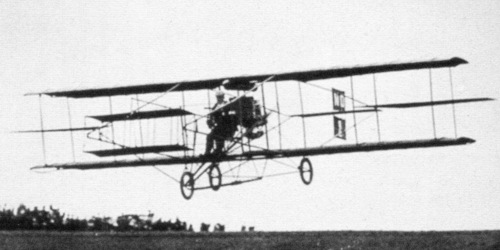
Curtiss "Golden Flyer"
Pilot: Charles Willard
Engine: 25 hp Curtiss I-4
Pilot: Charles Willard
Engine: 25 hp Curtiss I-4
According to the program Willard's plane should
have had number 9. Here it carries number 1, but the
photo might be from some other meeting. It is easily
recognized by the wing tips that extended outside the
outer wing struts. (2)

2
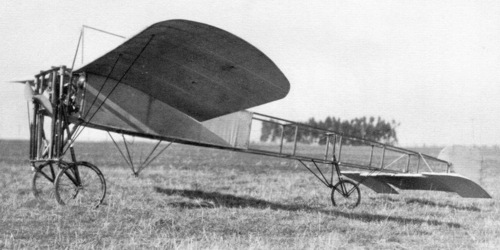
Blériot XI
Pilots: Louis Paulhan
Engine: 25 hp Anzani 3-cyl.
Pilots: Louis Paulhan
Engine: 25 hp Anzani 3-cyl.
The Paulhan "equipe" brought two identical
standard Blériots to the meeting. This one appears to
carry a loosely attached race number 2. (3)
(3)(4)
Blériot XI
Pilots: Didier Masson and Charles Miscarol
Engine: 25 hp Anzani 3-cyl.
Pilots: Didier Masson and Charles Miscarol
Engine: 25 hp Anzani 3-cyl.
One of Paulhan's Blériots was damaged early during
the meeting and probably never carried any race
numbers. #3 should have been Masson and #4 Miscarol.
(2)

5
Curtiss
Pilot: Charles Hamilton
Engine: 25 hp Curtiss V-8
Pilot: Charles Hamilton
Engine: 25 hp Curtiss V-8
(4)

6
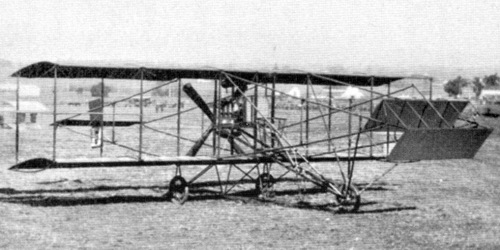
Curtiss "Rheims Flyer"
Pilot: Glenn Curtiss
Engine: 50 hp Curtiss V-8
Pilot: Glenn Curtiss
Engine: 50 hp Curtiss V-8
The only V8-powered Curtiss at the meeting. According
to the race program it was number 6 and it looks like
it still carried the Brescia meeting race number 6 on
the rudder. (3)
7
Curtiss
Pilot: Charles Hamilton
Engine: 25 hp Curtiss I-4
Pilot: Charles Hamilton
Engine: 25 hp Curtiss I-4
Hamilton's plane was number 5 according to the
program, but here it appears to carry number 7. It can
be recognized by the four-blade propeller. (2)

(7)
Klassen "Butter-Fly"
Pilot: Jacob H. Klassen
Engine: ?
Pilot: Jacob H. Klassen
Engine: ?
Note the big angled control surface above the wing. It
was for roll control and was presumably designed to
avoid infringing the Wright patents. The plane was
damaged early during the week and probably never
carried its assigned race number. (2)
8
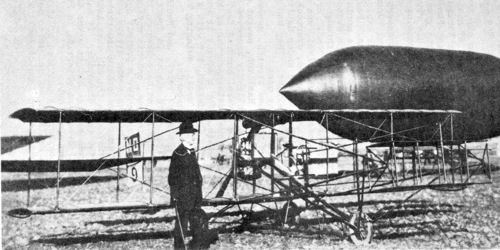
"Wright with Curtiss chassis"
Pilot: Roy Knabenshue
Pilot: Roy Knabenshue
Did not participate
9
Curtiss "Golden Flyer"
Pilot: Charles Willard
Engine: 25 hp Curtiss I-4
Pilot: Charles Willard
Engine: 25 hp Curtiss I-4
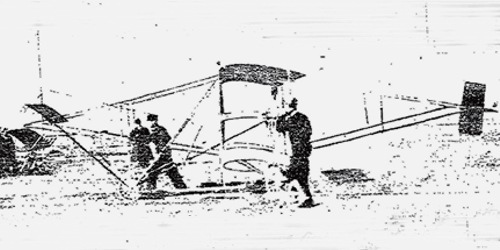
The wing tips that extend outside the outer wing struts
identify this as the "Golden Flyer", this
time with its correct race number. (4)
10
Gill-Dosh
Pilot: Hillery Beachey
Engine: 26 hp ?
Pilot: Hillery Beachey
Engine: 26 hp ?
Built by Howard W. Gill of Baltimore using measurements
taken from the Curtiss "Rheims Flyer" and a
converted automobile engine. A better photo would be
very welcome...(5)

11
Curtiss
Pilot: Clifford Harmon
Engine: 25 hp Curtiss I-4
Pilot: Clifford Harmon
Engine: 25 hp Curtiss I-4
(2)
Eaton-Twining
Pilot: Warren S. Eaton?
Engine: 22.5 hp Ford I-4
Pilot: Warren S. Eaton?
Engine: 22.5 hp Ford I-4
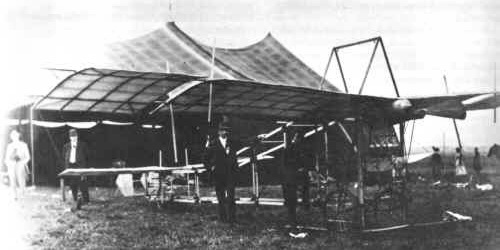
This was the more credible of the two planes that Los
Angeles Polytechnic High School professor Twining
brought to the meeting - the other was a man-powered
ornithopter. Note the sliding wing-tip panels that were
used for lateral control, another effort to avoid
infringing the Wright patent. (6)
Smith "Dragonfly II"
Pilot: Edgar Smith
Engine: 15 hp O-2
Pilot: Edgar Smith
Engine: 15 hp O-2
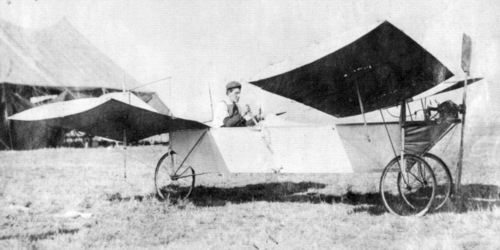
A tandem monoplane with variable-incidence wings for
pitch control. The engine didn't have power enough
to enable flights. (2)

Zerbe
Pilot: James S. Zerbe
Engine: 25 hp 8-cyl.
Pilot: James S. Zerbe
Engine: 25 hp 8-cyl.
This unique quintuplane was built by Zerbe, a professor
of the Los Angeles Polytechnic High School. (2)
