
Germany, August 16th - 22nd, 1910
The first cross-country air race in Germany
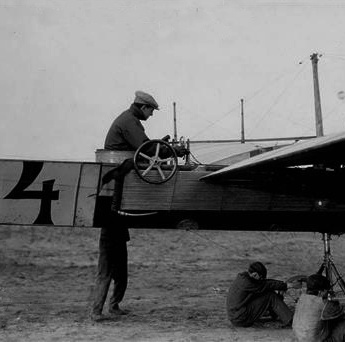
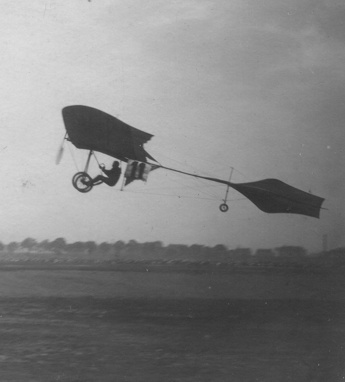
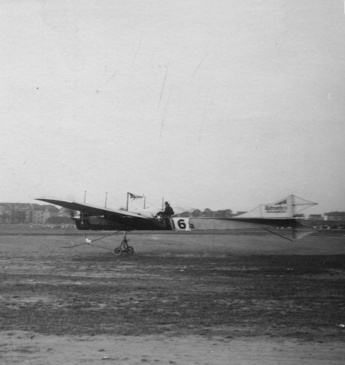
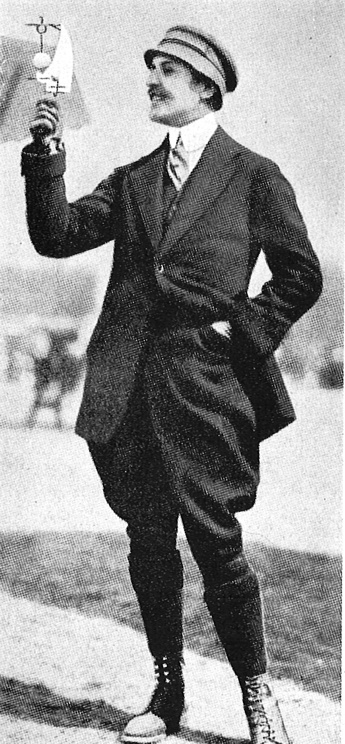
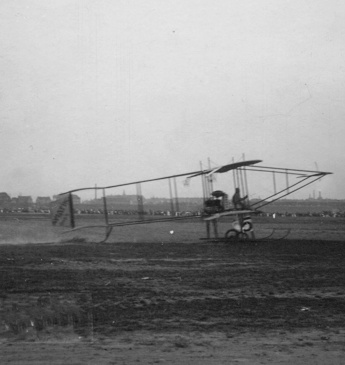
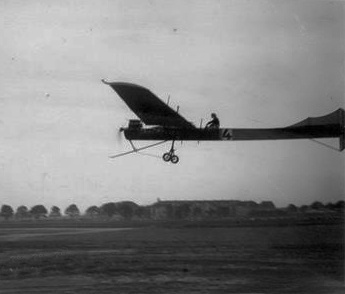
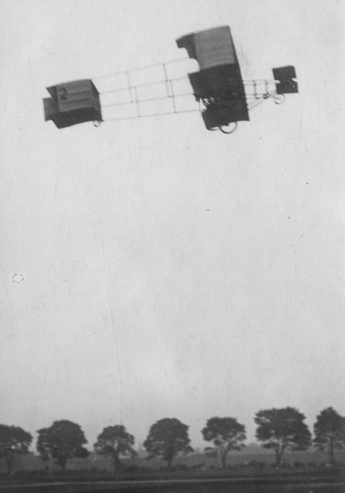
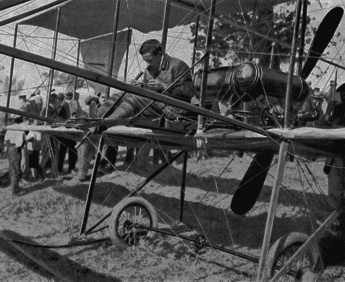
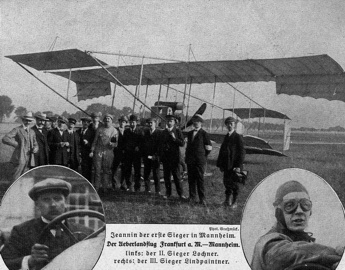
The Deutsche Fliegerbund was formed in April 1910, at a meeting between many different
German aviation organisations. The object of the organisation was to advance and promote
German aviation. Prinz Albert zu Schleswig-Holstein-Glücksburg was elected as the first
president.
Realizing that German aviation was not as advanced as particularly the French, they looked
at several ways to encourage development. One of these was to increase the amount of prize
money made available for aviation contests. In June they proposed their first event, a
cross-country race from Frankfurt am Main to Mannheim, via Wiesbaden and Mainz. The
selection of a cross-country race was based on their conviction that distance flying would
be more beneficial to the development of aviation then closed-course racing. A committee,
headed by Oberst Emil Ilse, was formed in order to organize the contest together with a
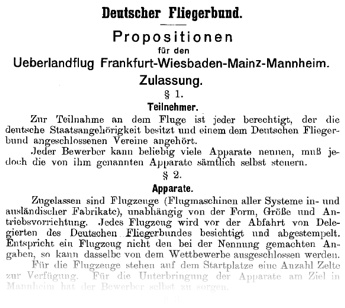
group of active flyers. The rules were published in the end of July.
The rules stated that only German citizens could enter, but they could use airplanes of any
nationality. The course started at the Griesheimer Exerzierplatz, around five kilometres
west of central Frankfurt. Each pilot had to fly a circle around the field before leaving.
There were two control points, at the Wiesbadener Rennplatz (racecourse), around six
kilometres southeast of Wiesbaden, and at the Mainzer Sand military exercise grounds, on
the sand dunes around five kilometres west of central Mainz. The finish was at the
Mannheimer Rennplatz, at the Luisenpark around two kilometres east of central Mannheim. The
control points would be indicated by tethered balloons, and the finish at Mannheim by a
large cross marked on the ground. The straight-line distance was around 95 kilometres, but
it was expected that most pilots would follow the Main and Rhine rivers to simplify
navigation, resulting in a course length of 105-110 kilometres.
Flights could be made on any day between August 16th and 22nd. The competitors could make
as many flights as they wanted. Stops for refuelling and repairs could be made at the
control points, and if such stops took less than one hour they would not be counted as
flying time. Longer stops, and stops at other places along the course, would be included in
the time. If a pilot carried a passenger, weighing at least 55 kilograms, 15 minutes would
be deducted from the flying time. Apart from the main contest there was also a
"Zuverlässigkeitspreis" (reliability prize), offered to the pilot who could land
at the Mainzer Sand at exactly a day and time to be specified by organizers.
At the entry deadline on August 12th, ten entrants had paid the 300 Mark entry fee (the two
missing race numbers were for machines provisionally entered by the German Wright company
and later withdrawn):
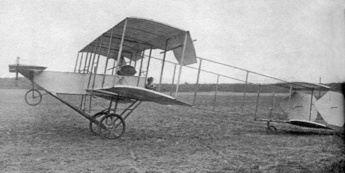
1. Richard von Tiedemann (Sommer)
2. Erich Lochner (Euler)
3. Ellery von Gorrissen (Euler)
4. Walter von Mumm (Antoinette)
5. Emile Jeannin (Aviatik)
6. Eugen Wiencziers (Antoinette)
7. Otto Lindpaintner (Sommer)
8. Robert Thelen (Wright)
11. Ernst Plochmann (Grade)
12. August Euler (Euler)
On August 5th, it was announced that the control point at the Wiesbadener Rennplatz was
deleted, because it was not suitable for landing. It was also announced, probably for
similar reasons, that the finish would not be at the Mannheimer Rennplatz, but at the
Exerzierplatz, around two kilometres to the north. This shortened the straight-line race
distance to around 91 kilometres.
A relay car service had been organized by local automobile associations, so that medical
personnel would be able to follow the flyers along the Rhine, where the direction to the
finish would be indicated by three-metre-long boards arranged as arrow heads. Given the
conditions during the flights, it is questionable whether any of these services were of any
actual use.
Fourteen tent hangars had been built at the Griesheim field, and from August 10th they
started to fill up. The first practice flight at the was made on August 13th. Erich Lochner
took off early in the morning and toured several towns and villages around the field during
a flight of an hour and a half. The day after, August Euler flew in from his factory in
Griesheim west of Darmstadt (not the same Griesheim as the Frankfurt airfield!), a flight
of around 40 kilometres. This was hailed as the first time in Germany that a participant
flew to a meeting, which is questionable, since Hubert Latham had flown from Tempelhof to
Johannisthal on 27 September 1909 in order to participate in the first Berlin Flugwoche.
The weather on the evening before the first day was miserable, with rain, thunder and
lightning.
Reports in the press from the different airfields were rather confused and contradictory.
The times given for the different take-offs and emergency landings are somewhat
provisional, since they have been gathered from several sources.
Tuesday 16 August
The weather was bright and sunny and preparations for the "reliability prize"
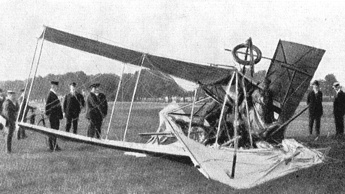
started early in the morning. At 06:15, von Tiedemann took off for a test flight. After
only a couple of hundred metres his machine suddenly banked to the right and crashed from
an altitude of around 30 metres. Emergency personnel quickly retrieved the pilot from the
wreckage and transported him to the field hospital. He was initially unconscious, but after
a while he was able to speak with the doctors. He had been hit by the fuel tank and his
injuries were serious, but fortunately not life-threatening. He had suffered multiple
fractures on his right thigh and a deep flesh wound on the left leg. He blamed the accident
on a sudden control system failure.
The start of the reliability contest was scheduled for 10:30, but the winds constantly
changed in strength and direction, and thunder threatened. Five pilots had entered: von
Tiedemann, Lochner, von Gorrissen, von Mumm and Jeannin. The first pilot to appear on the
starting line, at 11:15, was von Mumm. After three tries he managed to take off, but he was
forced to land on a stubble field immediately outside the airfield and decided to give up.
Plochmann also tried to take off, but was forced to the ground by a gust and broke his
landing gear. Shortly before noon the officials announced that the reliability contest was
called off. In the evening Lochner and Thelen made test flights, the former suffering an
engine failure.
Wednesday 17 August
The weather was calm and action again started early in the morning. Thelen took off and
left the airfield at 5:54, with his competitor von Gorrissen as passenger. They passed the
tethered marker balloon at the Mainzer Sand control at 6:25, at an altitude of 260 metres,
and continued southwards without landing. After around seven kilometres a cylinder jacket
burst and forced them to land, close to Weisenau. They were lucky to land close to the
Mainz Automobil-Fachschule (automotive school), where they had a similar engine and could
replace the broken cylinder. They could continue after only an hour and a half, but they
soon landed again, near Ginsheim. They remained there until six o'clock in the
afternoon, when they took off. The engine soon overheated again and they were forced to
land again near Gernsheim, where they gave up and started dismantling the machine for
transport.
Later in the morning von Mumm, Lochner and Plochmann made test flights in Frankfurt. Von
Mumm was forced to land in a garden and broke the propeller and the landing gear. Lochner
circled the airfield several times, but his machine had engine problems which were reported
to need major work.
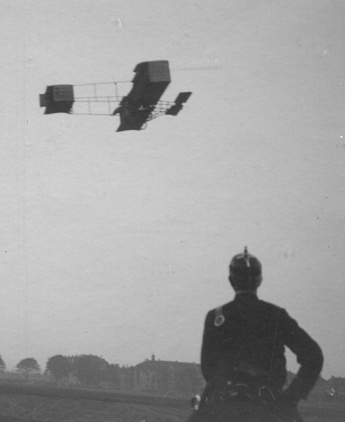
At 18:03 Wiencziers took off from Frankfurt. His flight along the river was followed by
thousands of spectators. He landed at Mainzer Sand half an hour later. He had intended to
continue to Mannheim after a short stop, but a wheel broke during his take-off. He decided
to continue the next day.
Jeannin started from Frankfurt at 18:31 and also reached Mainzer Sand after half an hour.
He took off again at 19:18, but got lost on the way to Mannheim and wasted a lot of time.
Darkness and mist forced him to land in a potato field close to the hospital and cemetery
of Sandhofen, less than six kilometres from his destination, at 20:35. He claimed that the
lights from the railways and other installations made it impossible to navigate around
factory chimneys and other obstacles in the haze.
Thursday 18 August
Wiencziers took off from the Mainzer Sand at 5:47, but he was forced to land in Astheim
after 15 minutes because of an engine failure. He decided to have his machine dismantled,
and already at 9:30 it was loaded on a car for transport back to Frankfurt. According to
one report, Thelen's machine had been transported back to Mainzer Sand, and was tested
at 7:45.
Jeannin's machine remained overnight in the field where he had landed. He initially
announced that he would return the machine to Frankfurt for a second try, and the machine
was dismantled. During the morning he was informed by the officials in Frankfurt that he
would be allowed to finish the flight despite not reaching the finish in time, since his
time on the ground overnight would anyway be included in the flight time. Jeannin then
changed his mind and started to reassemble the machine, announcing that he would probably
be able to take off at four o'clock in the afternoon. He then found out that he had to
replace the radiator, which had been damaged. This meant that he could only make the first
tests at five o'clock, and by that time it was too windy. He finally took off at 19:38.
He climbed to 300 metres, but he found the wind conditions too gusty and since he also
noticed an elevator control problem he turned back and landed in the same field.
Plochmann made several test flights in Frankfurt, but he decided to stay there for the day.
Von Gorrissen also made a test flight, his first. Euler had still not made any tests.
Lindpaintner finally arrived in Frankfurt, delayed by his participation in the Circuit de
l'Est. He stated that he would probably not be able to make his flight until the
Saturday. Von Mumm crashed during a test flight and his machine was badly damaged.
Friday 19 August
Von Gorrissen announced that he would make his effort, and took off from Frankfurt at 5:15.
After flying a couple of practice laps around the field his engine failed. It was reported
that a bigger fuel tank that had been installed made his machine unstable. He crashed
heavily and the machine was completely wrecked. It was reported that only the engine was
salvageable, but von Gorrissen fortunately escaped injuries.
Later in the morning Plochmann made some demonstration flights. During one of them his
engine stopped and he was forced to land. He got out and restarted the engine, but he was
careless with the controls when getting back on board. The propeller struck the ground and
the machine stood on its nose. The propeller was broken, and it was suspected that the
engine might also have been damaged. Lochner's machine was back in working order. He
planned to make test flights during the day, but it appears that no more flights were made
during the day.
Jeannin had announced that he would probably not take off from Sandhofen until around noon,
but since the wind conditions improved somewhat he decided to take off in the morning,
already at 7:07. He must have been helped by tailwind, because he landed at the Mannheimer
Exerzierplatz only three minutes later. The officials there were caught by surprise and
hardly had time to reach the finish line with their timing equipment. Despite the gusty
wind Jeannin made a perfectly controlled landing. He stated that it had been very difficult
due to the winds and that the machine had been tossed around by the turbulence. The
soldiers who had been exercising at the parade ground broke their ranks when they saw the
machine approaching and helped moving the plane to the hangars. Jeannin intended to
transport it back to Frankfurt but agreed to make a display flight first. He took off at
8:40 and circled the field, and then immediately started to dismantle the plane. Since
Jeannin had completed the distance he was the leader of the contest, but his total time was
36 hours 40 minutes, so it would be easy to beat…
Saturday 20 August
Jeannin's machine was back in Frankfurt after a twelve-hour 240-kilometre drive on a
Daimler lorry provided by the Freudenberg-Weinheim company. Wiencziers, Lochner and
Lindpaintner were reportedly all ready to fly, but with wind speeds of around 12 m/s nobody
wanted to take off in the morning. When the wind reduced, Lindpaintner, Lochner and
Plochmann made test flights, but with thunderstorms and heavy rain approaching in the
afternoon nobody wanted to take off with a fully loaded airplane. The hangar housing
Jeannin's and Lochner's machines partially collapsed from the rain during the
thunderstorm, but the planes were pulled out in time and were not damaged.
Sunday 21 August
The weather finally improved, and Lochner was first to take advantage. He took off at 5:08
in the morning, followed ten minutes later by Lindpaintner. Lochner landed at Mainzer Sand
at 5:48, while Lindpaintner almost immediately turned back and returned to the Frankfurt
field to have a control system problem fixed. Jeannin took off from Frankfurt at 5:59.
Lindpaintner made a second take-off at 6:14. Lochner took off from Mainzer Sand at 6:25.
Jeannin acually crossed Lochner's path in the air over Kastel, flying some fifty metres
higher. At 6:34 Jeannin passed the Mainzer Sand control, without landing, and continued
towards Mannheim.
Tension grew at the Mannheim field and news were constantly telephoned in - who would
arrive first? At half past seven it was reported from Worms, some 15 kilometres away, that
Jeannin had passed by. Everybody looked towards the northwest, and finally his airplane was
spotted, flying low over the trees that bordered the field. It looked like he didn't
find the field immediately and continued along the northwest side of the field before
climbing and turning back. He then headed straight for the finish line and touched down in
front of the enthusiastic crowd at 7:45. The official time of the flight was 1 h 45:41. He
was completely exhausted, having taken off without breakfast and worked hard during the
entire flight. "I've never made such a dangerous flight!" he said. "The
worst part was the turbulence in the Rhine valley. The aircraft was tossed about so
violently that I feared I would get seasick. It was a rocking motion, like a boat at sea.
The valley was so misty that I couldn't see fifty meters ahead, so I lost my bearings a
bit. Only over Lampertheim I realized that I had drifted a little too far to the
right." When asked why he hadn't landed immediately when reaching the
Exerzierplatz he replied that the engine had lost power and he wanted to gain some altitude
before turning back against the wind.
But where was Lochner - there were no news of his whereabouts? He finally arrived and made
a smooth landing a 9:27, which gave a total time of 3 h 41:44. It turned out that he had
been forced to land soon after taking off from Mainzer Sand. He was lucky to find a
clearing in the forest close to Geinsheim when his engine quit. After fixing the problem he
searched for help. After half an hour he finally found some locals who could help him move
the plane to a field where he could take off. The engine start almost ended in disaster.
The helpers, shocked by the noise of the engine and believing that it would explode, let go
and ran away. The plane almost took off without its pilot, but Lochner managed to control
it and convince the helpers to come back for a second effort.
And where was Lindpaintner? He had also decided to fly to Mannheim without stopping at
Mainzer Sand. After passing the control he had engine problems and had to land in
Geinsheim, around a quarter of the way between Mainzer Sand and Mannheim. He was able to
fix the problems himself and take off, but decided to fly back to Frankfurt for a second
try, rather than continuing to the finish. He was spotted from the Griesheim airfield
towards the afternoon, arriving at high speed from the west. He circled the airfield
several times at high altitude, before making a neat and controlled landing, despite the
high winds. Later in the afternoon it started raining and the wind increased, so no further
flights were made.
Thelen's crew tried to tow the disassembled Wright to Frankfurt on its own wheels
behind a car, but the landing gear broke on the way. It was necessary to load the machine
on a lorry in order to complete the transport, and when it arrived at the airfield there
was no time to prepare it to fly on the next day.
Monday 22 August
The rainy weather continued during the last day of the event, but it didn't discourage
Lindpaintner and Wiencziers from a last effort. Lindpaintner took off from Frankfurt at
13:50 and reached Mainzer Sand in 36 minutes. His original plan was to continue without
stopping, but the wind was so strong that the controls were almost ripped out of his hands,
and he decided to land. It continued to rain heavily, so the stop lasted much longer than
he had hoped for. The machine had to be brought into one of the hangars that had been built
on the dunes.
Wiencziers took off from Frankfurt at 14:20, but only got as far as Hattersheim, around ten
kilometres from the start. He had engine problems, but the landing apparently also caused
other damages. Mechanics were called in and repaired the plane, but Wiencziers decided that
it was impossible to continue the race. Towards the evening the weather improved, and he
could take off from the field where he had landed. After a very fast flight, aided by a
strong tailwind, he landed back in Frankfurt at 19:25, when almost everybody had left the
field.
Lindpaintner was stuck at Mainzer Sand until 16:22, when the rain had eased and he took off
for Mannheim. He almost reached the goal, and it was even reported that he was sighted from
Mannheim, but a violent thunderstorm forced him to turn back. He landed at Nordheim, around
two thirds of the way between Mainzer Sand and Mannheim, to wait for better weather. He
could only take off again around seven o'clock, and then made a second landing at the
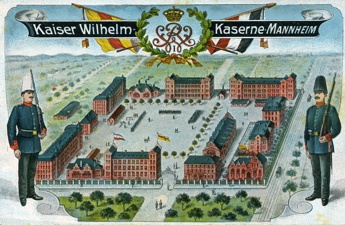
Landesgefängnis (state prison), around one kilometre northwest of the Exerzierplatz. He had
mistaken the prison buildings for the Kaiser-Wilhelm-Kaserne barracks immediately southwest
of the Exerzierplatz and landed in front of them. He had also seen a light strip on the
ground, which he believed was the finish line cross, but it was actually only reflections
in standing water. He almost immediately realized his mistake and took off again,
unassisted, for the short flight to the actual finish line, which he reached at 19:47, just
as thunderclouds started to gather again. His total time was 4 h 56:44. After landing he
stated that he would never have started the flight if he had been aware of the difficult
wind conditions along the Rhine. The wind speeds had reached 18 m/s at most, almost the top
speed of his Sommer biplane, and the turbulence in the valley had been very bad. Hundreds
of people gathered around the machine and cheered wildly. The tent hangar that had been
built for the event had collapsed during the thunderstorm, so the machine was brought to
protection under some scaffolding. The officials wanted Lindpaintner to make a display
flight, and after some persuasion he finally accepted. He started the engine and flew two
circuits around the field in the increasing darkness.
In the evening, the Deutsche Fliegerbund held a closing banquet at the Frankfurter Hof,
which was attended by all the aviators except Lindpaintner, who was still in Mannheim. The
president of the organization, Prince Albert von Schleswig-Holstein, offered a toast to the
aviators. Colonel Ilse said in his speech that one could be proud of the achievements of
the German aviators. Several honorary prizes were awarded.
Conclusion
Lochner filed a protest against the result, claiming that Jeannin had not passed the
control at Mainzer Sand in the regulated way. The protest was apparently dismissed or
withdrawn, so Jeannin's win was confirmed.
The organization and results of the contest caused some controversy in German aviation
circles. The "Deutsche Zeitschrift für Luftschiffahrt" published a very critical
article, headed "Mehr Sport beim Fliegen" ("More sport in aviation").
They compared the Frankfurt-Mainz-Mannheim contest with the Circuit de l'Est, and the
recent meeting in Berlin with that of Reims, and found the situation painful and
embarrassing for Germany. They blamed both the airplane manufacturers and the pilots for
their lack of ambition and their lack of will to actually fly their machines. They also blamed
sponsors and meeting organizers for not raising enough prize money, and the government for
spending huge amounts of money on airships, rather than airplanes.
August Euler replied in "Flugsport" that the German pilots had nothing to be
ashamed of. He stated that the prize funds of the event was only a fraction of those
offered by "Le Matin" and several sponsors for the Circuit. 10 out of the 20
German licensed pilots had been present at the start of the Überlandflug, compared to 16
out of 162 French licensed pilots for the Circuit de l'Est. The performance of the
German pilots, particularly Lindpaintner's flights during the thunderstorms, was second
to none. The Circuit de l'Est had been flown in better weather and mainly over flat
farmland, while the Überlandflug course followed rivers surrounded by steep banks, forests,
and lots of towns and villages.
