
Grande Semaine d'Aviation
Caen, France, July 27th - August 2nd, 1910
Caen, France, July 27th - August 2nd, 1910
The Caen-Cormelles airfield
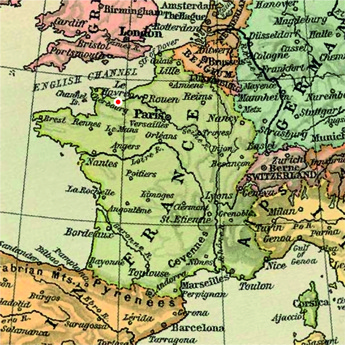
Before the meeting, sixteen temporary Bessonneau hangars were erected, and grandstands were constructed by the Cambronne company. Several bars and restaurants were built, and telephone lines were installed. The installations were of a less grand scale than on several other meetings. Another simplification was that the organizers decided against using the customary mast with complicated signals to inform about the ongoing events and instead used flags of different colours to inform about the different events.
The field was reportedly used for several more aviation meetings, while horse racing and military activities also continued. In 1931 the "Aéro-Club de Caen et du Calvados" was formed by merging the aero clubs of Caen and Calvados. It started operations on the field, initially with bungee-launched gliders and from 1933 with power-driven planes. Flying activities continued, still in parallel with horse racing and military exercises, until 1939, when increased military activities forced the club to move to the new Caen-Carpiquet airfield some six kilometres west of the town.
Caen was severely damaged during WW2, and in order to face the housing crisis it was decided to use the area for the new housing district "La Guérinière". The development began in 1955 and ended in 1961.
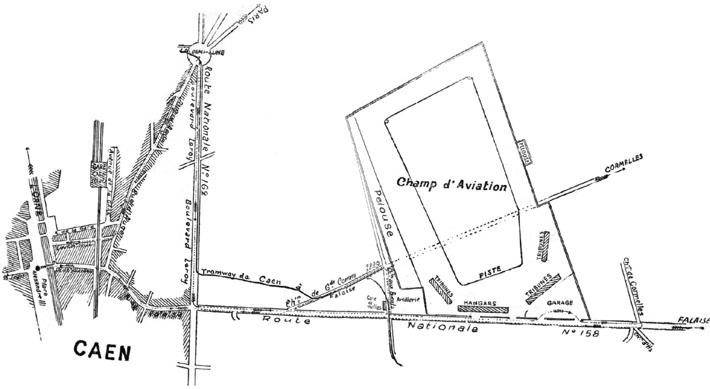
The plan of the airfield and the access roads from one
of the meeting programs. North is at around ten
o'clock.
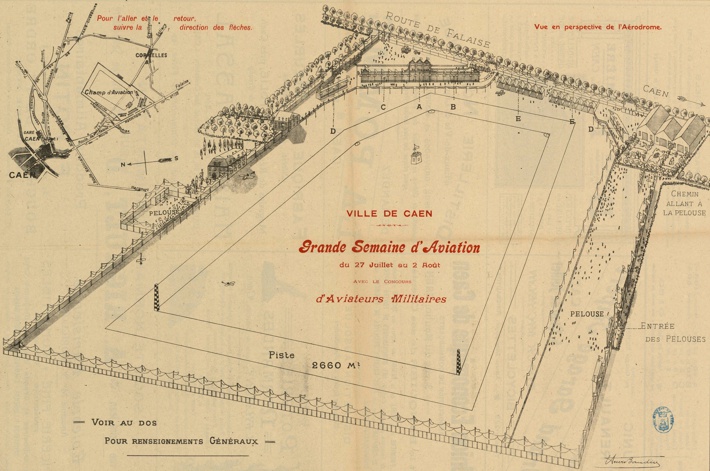
A magnificent drawing of the airfield. Click
 here for a bigger version. (1)
here for a bigger version. (1)
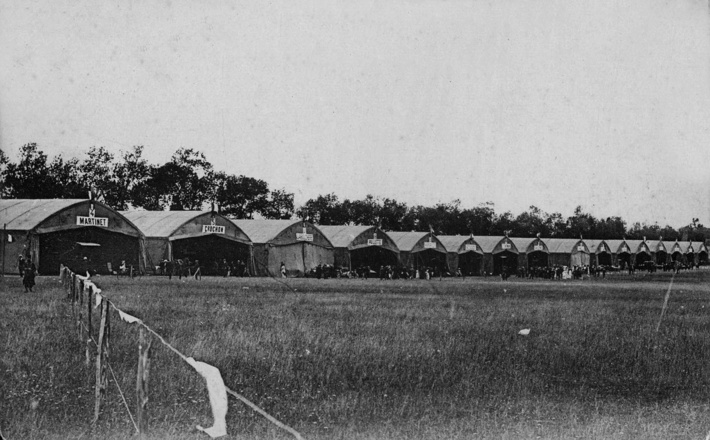
The line of sixteen Bessonneau
temporary hangars, seen from the south. (2)
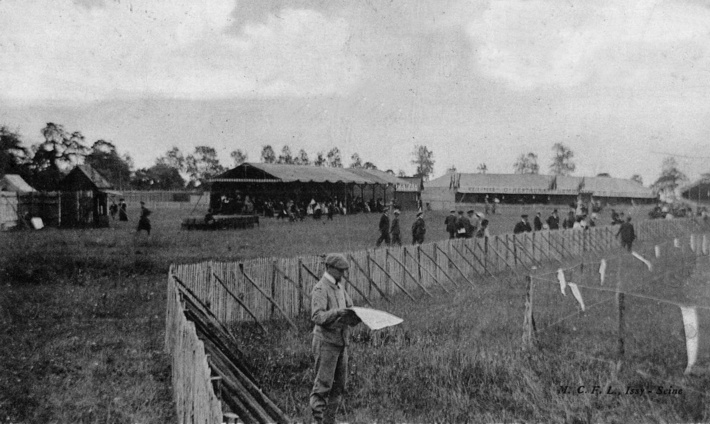
The grandstands were not as big
or luxurious as at many other meetings with bigger
budgets and bigger crowds. (3)
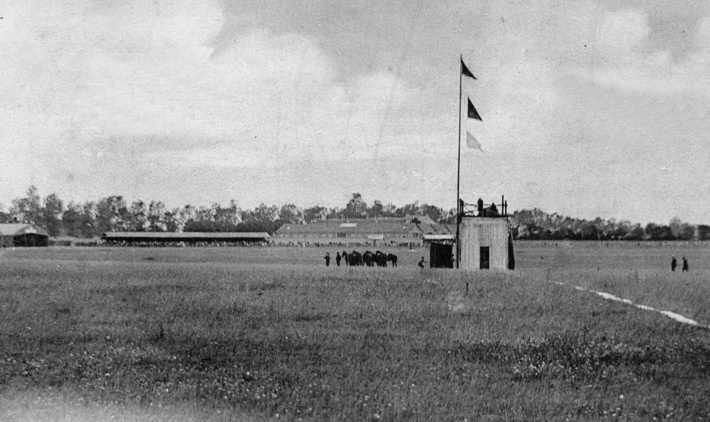
The timers' post and the
start/finish line. The different events were indicated
by simple coloured flags, instead of the intricate
signal masts used at many other events. (3)
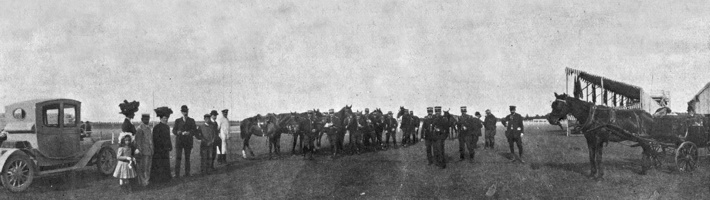
Order at the meeting was ensured
by soldiers from the 36e Régiment
d'Infanterie. (4)
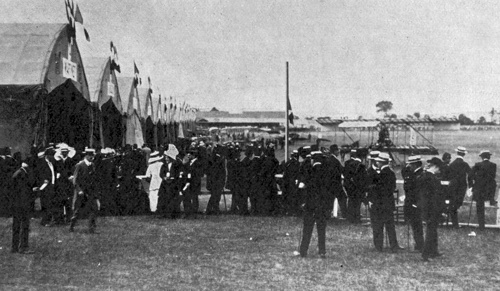
Visitors watching the crew of Robert Martinet, who had the hangar at the south end of the row, working on his Farman. (4)
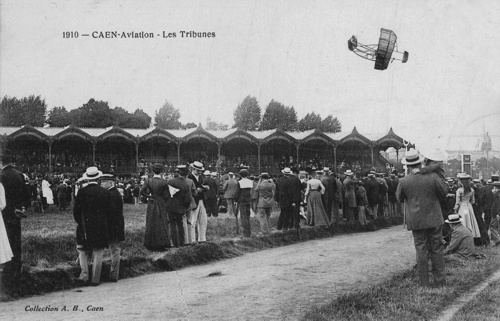
A couple of "Caen-Aviation" postcards were actually photo montages from the "Hippodrome de la Prairie", a horse-race course close to the centre of Caen. Perhaps it was originally intended to hold the meeting there? (5)
Too see more details, open the maps in Google Maps by
clicking the "full screen" symbol at the top
right of the menu bar!
Back to the top of the page