
Blackpool Flying Carnival
Blackpool, UK, July 28th - August 20th, 1910
Blackpool, UK, July 28th - August 20th, 1910
The Blackpool airfield
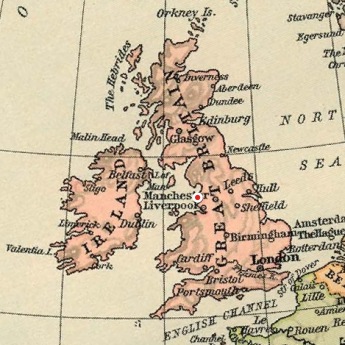
For the 1910 Flying Carnival only the northern part of the 1909 field was used, and the length of the rectangular marked course was reduced to one mile (1,609 m). The grandstands and hangars were completely rearranged in a much smaller area. It was hoped to establish it as a permanent airfield, with permanent hangars and grandstands, but after the huge losses of the Carnival these plans came to nothing.
In 1911 the Clifton Park racecourse opened on the site. It went bankrupt in 1915 and the site was requisitioned for a military hospital, the Lancashire Military Convalescent Home. This closed in 1924, and afterwards the field was occasionally used for flying, and from 1933 for greyhound racing. Scheduled flights from the field started in 1933, in competition with the Stanley Park airfield east of Blackpool, which had been opened in 1928. The airfield was expanded and used by minor airlines until 1937, when it was taken over by the Air Ministry and civilian operations moved to Stanley Park. It was further expanded and became RAF Squires Gate, which was used by several squadrons and training units during WW2. Some 2,500 Vickers Wellington bombers were produced in a Ministry of Aircraft Production factory at the northeast corner of the field. Some airlines started using the field in 1946 and the airfield became civilian again in 1949. It was renamed Blackpool Airport and used by several airlines. After a series of ownership changes commercial flights ceased in 2014. The terminal building was demolished in 2016, and the airfield is now mainly used by flying clubs and by offshore helicopter and executive flight operators.
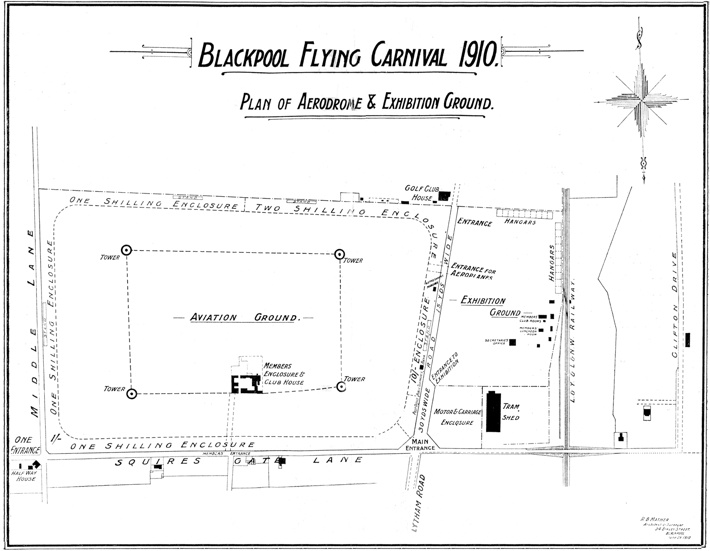
The plan of the airfield from meeting program. North is
at seven o'clock.
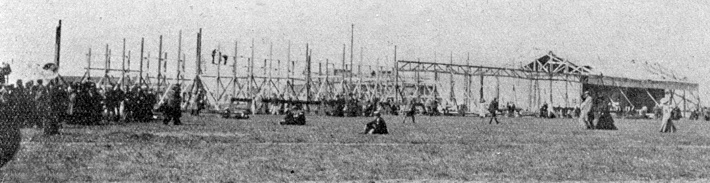
The hangars for biplanes on the second day of the
meeting. Due to rain and delayed construction work only
one of them has a roof. (1)
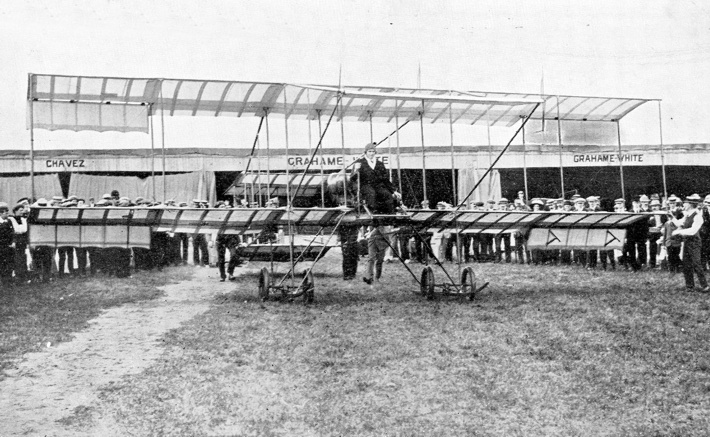
Claude Grahame-White and his
Farman in front of the hangars. (2)
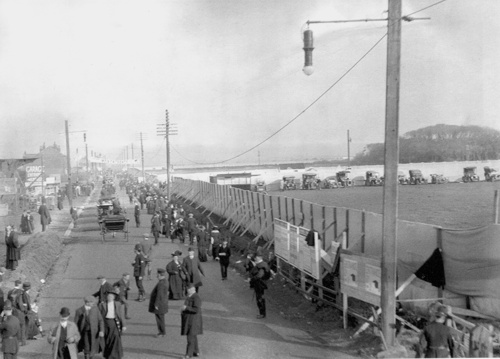
Outside the main entrance on Squires Gate Lane. (3)
Too see more details, open the maps in Google Maps by
clicking the "full screen" symbol at the top
right of the menu bar!
 Back to the top of the page